Comorbilidades del síndrome de intestino irritable en Colombia: análisis de datos del Ministerio de Salud
DOI:
https://doi.org/10.22516/25007440.1289Palavras-chave:
Síndrome de colon irritable, comorbilidad, fibromialgia, trastornos mentales, microbioma gastrointestinalResumo
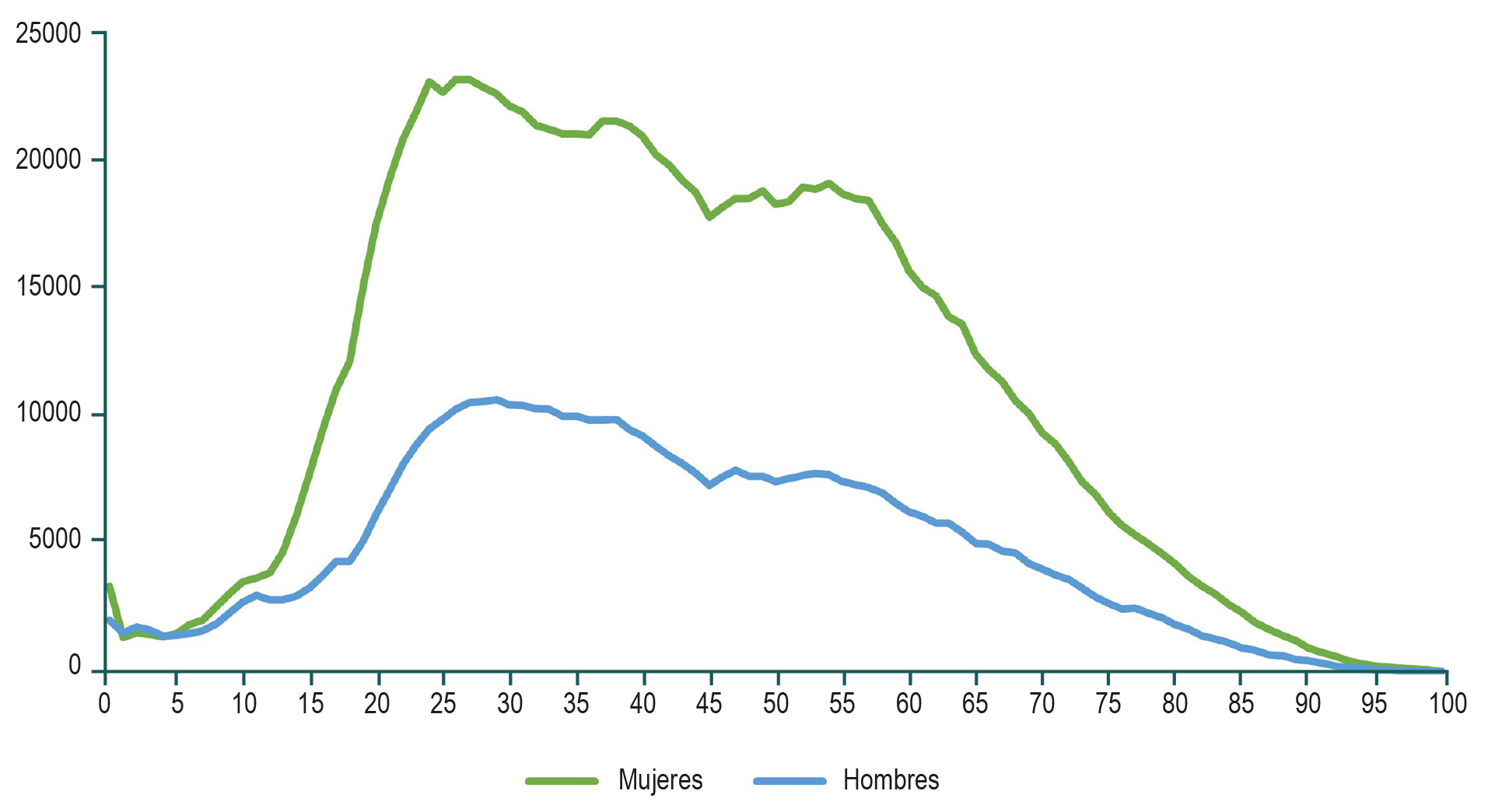
El síndrome de intestino irritable (SII) es el trastorno funcional más frecuente del tracto gastrointestinal y se caracteriza por alteraciones del tránsito asociadas a dolor abdominal crónico. Mediante el uso de los registros individuales de prestación de servicios de salud (RIPS) como base de datos del Ministerio de Salud de Colombia, se realizó un estudio descriptivo. Se utilizaron los códigos CIE-10 K580 (colon irritable con diarrea) y K589 (colon irritable sin diarrea) para todos los pacientes registrados entre 2018 y 2022, y se determinaron las razones de prevalencia de algunas de las comorbilidades descritas en la literatura en comparación con personas sin ese diagnóstico según la edad y sexo de los sujetos. Nuestros resultados muestran una menor prevalencia (2,7%) en Colombia en comparación con reportes previos con una razón mujer/hombre de 2,2. Los diagnósticos de fibromialgia, depresión, ansiedad, síndrome de ovario poliquístico, migraña, esquizofrenia y trastorno de estrés postraumático son más prevalentes en pacientes con diagnóstico de SII. La mayor tasa de prevalencia corresponde a la fibromialgia, con siete veces más diagnósticos en pacientes con SII, y la menor a la esquizofrenia, con un 36% más de diagnósticos. Se evidencia en la literatura vías patogénicas similares, como la alteración del microbioma intestinal, la alteración del metabolismo de neurotransmisores, la alteración de la permeabilidad intestinal, el ambiente intestinal proinflamatorio y la sensibilización neuronal. Por lo anterior, se enfatiza sobre el mayor riesgo de presentación de estas enfermedades entre los pacientes con SII, lo que demuestra un área de interés para posteriores investigaciones.
Downloads
Referências
Sebastián Domingo JJ. Síndrome del intestino irritable. Med Clin (Barc). 2022;158(2):76-81. https://doi.org/10.1016/j.medcli.2021.04.029
Mearin F, Ciriza C, Mínguez M, Rey E, Mascort JJ, Peña E, et al. Guía de práctica clínica: síndrome del intestino irritable con estreñimiento y estreñimiento funcional en adultos: concepto, diagnóstico y continuidad asistencial. Semergen. 2017;43(1):43-56. https://doi.org/10.1016/j.semerg.2016.06.009
Canavan C, West J, Card T. The epidemiology of irritable bowel syndrome. Clin Epidemiol. 2014;6:71-80. https://doi.org/10.2147/CLEP.S40245
Gómez DF, Morales JG, Aurelio LM, Mujica SC, Camacho PA, Rueda GE. Factores sociosanitarios y prevalencia del síndrome del intestino irritable según los criterios diagnósticos de Roma III en una población general de Colombia. Gastroenterol Hepatol. 2009;32(6):395-400. https://doi.org/10.1016/j.gastrohep.2009.01.177
Sperber AD, Bangdiwala SI, Drossman DA, Ghoshal UC, Simren M, Tack J, et al. Worldwide prevalence and burden of functional gastrointestinal disorders, results of Rome Foundation Global Study. Gastroenterology. 2021;160(1):99-114. https://doi.org/10.1053/j.gastro.2020.04.014
Bustos-Fernández LM. Síndrome de intestino irritable: la importancia de los antiespasmódicos. Rev Colomb Gastroenterol. 2020;35(3):338-344. https://doi.org/10.22516/25007440.523
Garofalo C, Cristiani CM, Ilari S, Passacatini LC, Malafoglia V, Viglietto G, et al. Fibromyalgia and irritable bowel syndrome interaction: a possible role for gut microbiota and gut-brain axis. Biomedicines. 2023;11(6):1701. https://doi.org/10.3390/biomedicines11061701
Mayer EA, Ryu HJ, Bhatt R. The neurobiology of irritable bowel syndrome. Mol Psychiatry. 2023;28(4):1451-1465. https://doi.org/10.1038/s41380-023-01972-w
Wei Z, Chen Z, Xiao W, Wu G. A systematic review and meta-analysis of the correlation between polycystic ovary syndrome and irritable bowel syndrome. Gynecol Endocrinol. 2023;39(1):2239933. https://doi.org/10.1080/09513590.2023.2239933
Wongtrakul W, Charoenngam N, Ungprasert P. Increased prevalence of irritable bowel syndrome in migraine patients: a systematic review and meta-analysis. Eur J Gastroenterol Hepatol. 2022;34(1):56-63. https://doi.org/10.1097/MEG.0000000000002065
Amir Garakani, Win T, Virk S, Gupta S, Kaplan DS, Masand PS. Comorbidity of irritable bowel syndrome in psychiatric patients: A review. Am J Ther. 2003;10(1):61-67. https://doi.org/10.1097/00045391-200301000-00014
Ng QX, Soh AYS, Loke W, Venkatanarayanan N, Lim DY, Yeo WS. Systematic review with meta-analysis: The association between post-traumatic stress disorder and irritable bowel syndrome. J Gastroenterol Hepatol. 2019;34(1):68-73. https://doi.org/10.1111/jgh.14446
Rosselli D, Pantoja-Ruiz C. SISPRO: The administrative database of the Colombian healthcare system. Acta Neurol Colomb. 2022;38(4):187-190. https://doi.org/10.22379/24224022426
Fernández-Ávila DG, Rincón-Riaño DN, Bernal-Macías S, Gutiérrez JM, Rosselli D. Prevalencia de la artritis reumatoide en Colombia según información del Sistema Integral de Información de la Protección Social. Rev Colomb Reumatol. 2019;26(2):83-87. https://doi.org/10.1016/j.rcreu.2019.01.003
Triana Guzmán JJ, Aristizábal Mayor JD, Medina Rico M, Baquero Contreras L, Gil Tamayo S, Leonardi F, et al. Carga de enfermedad en años de vida ajustados por discapacidad del cáncer gástrico en Colombia. Rev Colomb Gastroenterol. 2017;32(4):326- 331. https://doi.org/10.22516/25007440.175
Fernández-Ávila DG, Rincón-Riaño DN, Bernal-Macías S, Gutiérrez Dávila JM, Rosselli D. Prevalence and demographic characteristics of Sjögren’s syndrome in Colombia, based on information from the official Ministry of Health registry. Reumatol Clin (Engl Ed). 2020;16(4):286-289. https://doi.org/10.1016/j.reuma.2018.09.005
Lovell R, Ford A. Global prevalence of and risk factors for irritable bowel syndrome: a meta-analysis. Clin Gastroenterol Hepatol. 2012;10(7):712-721. https://doi.org/10.1016/j.cgh.2012.02.029
Cañón M, Ruiz AJ, Rondón M, Alvarado J. Prevalence of irritable bowel syndrome and health-related quality of life in adults aged 18 to 30 years in a Colombian university: an electronic survey. Ann Gastroenterol. 2017;30(1):67-75. https://doi.org/10.20524/aog.2016.0093
Vergara-Alvira MS, Ahumada-Ossa LM, Poveda- Espinosa E. Estrés, depresión, ansiedad y el hábito alimentario en personas con síndrome de intestino irritable. Rev Colomb Gastroenterol. 2022;37(4):369-382. https://doi.org/10.22516/25007440.899
Holtmann G, Ford AC, Talley NJ. Pathophysiology of irritable bowel syndrome. Lancet Gastroenterol Hepatol. 2016;1(2):133-146. https://doi.org/10.1016/S2468-1253(16)30023-1
He S, Li H, Yu Z, Zhang F, Liang S, Liu H, et al. The gut microbiome and sex Hormone-Related diseases. Front Microbiol. 2021;12:711137. https://doi.org/10.3389/fmicb.2021.711137
De Roos NM, Van Hemert S, Rovers JMP, Smits MG, Witteman BJM. The effects of a multispecies probiotic on migraine and markers of intestinal permeability-results of a randomized placebo-controlled study. Eur J Clin Nutr. 2017;71(12):1455-1462. https://doi.org/10.1038/ejcn.2017.57
Albayrak B, Süsgün S, Küçükakkaş O, Akbaş F, Yabaci A, Özçelik S. Investigating of relation between fibromyalgia syndrome and intestinal microbiota. Mikrobiyol Bul. 2021;55(2):146-160. https://doi.org/10.5578/mb.20219903
Duan R, Zhu S, Wang B, Duan L. Alterations of gut microbiota in patients with irritable bowel syndrome based on 16s rRNA-targeted sequencing: a systematic review. Clin Transl Gastroenterol. 2019;10(2):e00012. https://doi.org/10.14309/ctg.0000000000000012
Todor TS, Fukudo S. Systematic review and meta-analysis of calculating degree of comorbidity of irritable bowel syndrome with migraine. Biopsychosoc. Med. 2023;17(1):22. https://doi.org/10.1186/s13030-023-00275-4
Gupta S, Masand PS, Kaplan DS, Bhandary AN, Hendricks SE. The relationship between schizophrenia and irritable bowel syndrome (IBS). Schizophr Res. 1997;23(3):265-268. https://doi.org/10.1016/s0920-9964(96)00099-0
Lee YT, Hu L, Shen C, Huang M, Tsai SJ, Yang AC, et al. Risk of psychiatric disorders following irritable bowel syndrome: A nationwide population-based cohort study. PLoS One. 2015;10(7):e0133283. https://doi.org/10.1371/journal.pone.0133283
Islam Z, D’Silva A, Raman M, Nasser Y. The role of mind body interventions in the treatment of irritable bowel syndrome and fibromyalgia. Front Psychiatry. 2022;13:1076763. https://doi.org/10.3389/fpsyt.2022.1076763
Erdrich S, Hawrelak J, Myers S, Harnett J. A systematic review of the association between fibromyalgia and functional gastrointestinal disorders. Therap Adv Gastroenterol. 2020;13:1756284820977402. https://doi.org/10.1177/1756284820977402
Ståhlberg L, Palmquist E, Nordin S. Intolerance to environmental chemicals and sounds in irritable bowel syndrome: Explained by central sensitization? J. Health Psychol. 2016;23(10):1367-1377. https://doi.org/10.1177/1359105316656242
Kearney DJ, Kamp K, Storms M, Simpson TL. Prevalence of gastrointestinal symptoms and irritable bowel syndrome among individuals with symptomatic posttraumatic stress disorder. J Clin Gastroenterol. 2022;56(7):592-596. https://doi.org/10.1097/MCG.0000000000001670
Suzuki K, Suzuki S, Shiina T, Kobayashi S, Hirata K. Central sensitization in migraine: A narrative review. J Pain Res. 2022;15:2673-2682. https://doi.org/10.2147/JPR.S329280
Qin HY, Cheng CW, Tang XD, Bian ZX. Impact of psychological stress on irritable bowel syndrome. World J Gastroenterol. 2014;20(39):14126-14131. https://doi.org/10.3748/wjg.v20.i39.14126
Bolino CM, Bercik P. Pathogenic factors involved in the development of irritable bowel syndrome: Focus on a microbial role. Infect Dis Clin North Am. 2010;24(4):961-975. https://doi.org/10.1016/j.idc.2010.07.005
Aizawa E, Sato Y, Kochiyama T, Saito N, Izumiyama M, Morishita J, et al. Altered cognitive function of prefrontal cortex during error feedback in patients with irritable bowel syndrome, based on FMRI and dynamic causal modeling. Gastroenterology. 2012;143(5):1188-1198. https://doi.org/10.1053/j.gastro.2012.07.104
Shulman RJ, Jarrett ME, Cain KC, Broussard EK, Heitkemper MM. Associations among gut permeability, inflammatory markers, and symptoms in patients with irritable bowel syndrome. J Gastroenterol. 2014;49(11):1467-1476. https://doi.org/10.1007/s00535-013-0919-6
Downloads
Publicado
Como Citar
Edição
Seção
Licença
Copyright (c) 2025 Revista colombiana de Gastroenterologia

Este trabalho está licenciado sob uma licença Creative Commons Attribution-NonCommercial-NoDerivatives 4.0 International License.
Aquellos autores/as que tengan publicaciones con esta revista, aceptan los términos siguientes:
Los autores/as ceden sus derechos de autor y garantizarán a la revista el derecho de primera publicación de su obra, el cuál estará simultáneamente sujeto a la Licencia de reconocimiento de Creative Commons que permite a terceros compartir la obra siempre que se indique su autor y su primera publicación en esta revista.
Los contenidos están protegidos bajo una licencia de Creative Commons Reconocimiento-NoComercial-SinObraDerivada 4.0 Internacional.