Inhibidores de bomba de protones y la calidad de vida en pacientes con globo faríngeo: un estudio observacional
DOI:
https://doi.org/10.22516/25007440.1178Palabras clave:
globo faringeo, calidad de vida, enfermedad por reflujo gastroesofágico, inhibidor de bomba de protonesResumen
Introducción: el globo faríngeo representa hasta el 4% de las consultas de otorrinolaringología. No existe consenso en la literatura con respecto a su tratamiento, pero la mayoría de estudios concuerda con que el reflujo gastroesofágico es el principal factor etiológico.
Objetivo: determinar si el tratamiento con inhibidores de la bomba de protones se asocia con cambios en la calidad de vida de una población con globo faríngeo.
Metodología: estudio observacional prospectivo de pacientes que acudieron a consulta externa por otorrinolaringología entre enero y diciembre de 2022, con diagnóstico de globo faríngeo. A todos se les realizó un estudio otorrinolaringológico completo y se empleó el índice de síntomas de reflujo (RSI), puntaje de hallazgos endoscópicos de reflujo (RFS), cuestionario GETS (Glasgow-Edinburgh Throat Scale) de globo faríngeo y el Cuestionario SF-36 antes y después de tres meses de tratamiento.
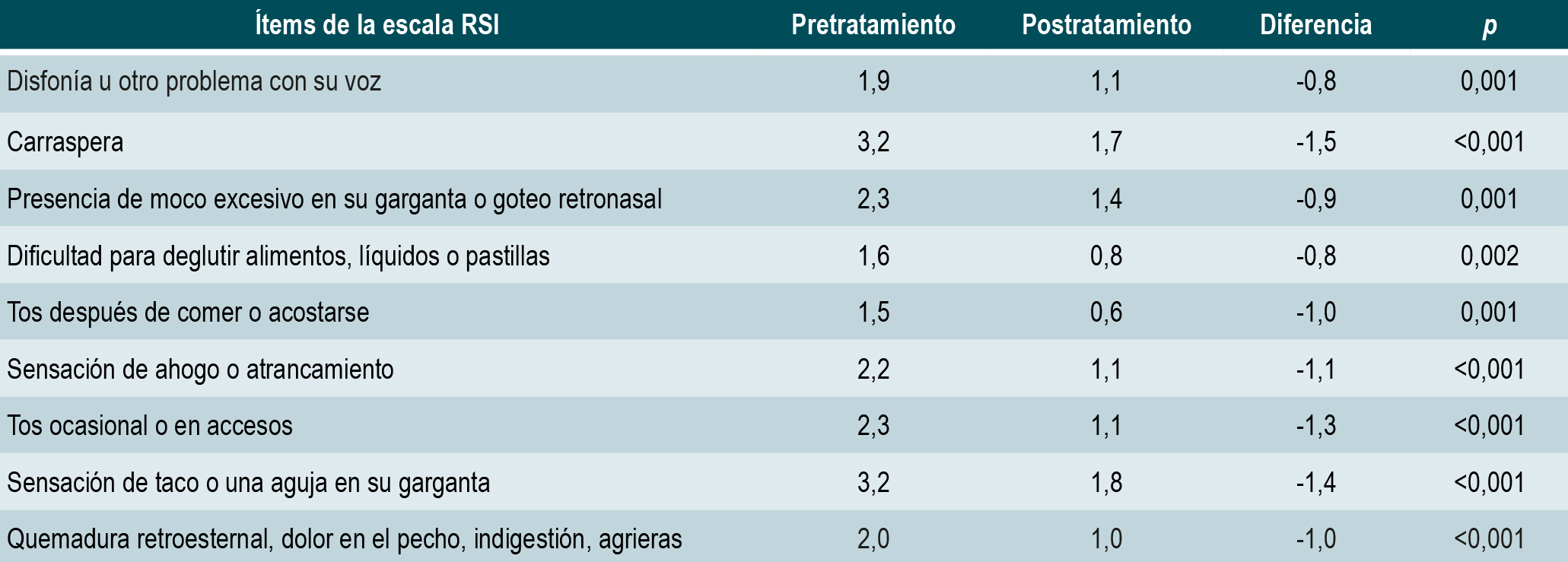
Resultados: la población de estudio estuvo conformada por 35 pacientes, 27 de los cuales fueron mujeres (77,1%), con una edad promedio de 55,2 años. Se observó mejoría en todos los puntos de la escala RSI. La calidad de vida mejoró después del tratamiento en las dimensiones de dolor corporal, la vitalidad, la función social, el rol emocional y la salud mental.
Conclusiones: en el presente estudio observacional, el tratamiento con inhibidores de la bomba de protones mejoró significativamente la sintomatología asociada con globo faríngeo.
Descargas
Referencias bibliográficas
Delaine E, Asimakopoulos A, Avagnina A, Hallak B, Bouayed S. Dysphagia with no obvious cause: globus pharyngeus. Revue Medicale Suisse. 2022;18(803);2121-2125. https://doi.org/10.53738/REVMED.2022.18.803.2121
Drossman D, Li Z, Andruzzi E, Temple R, Talley N, Grant-Thompson W, et al. U. S. Householder survey of functional gastrointestinal disorders - Prevalence, sociodemography, and health impact. Dig Dis Sci. 1993;38(9):1569-80. https://doi.org/10.1007/BF01303162
Harvey P, Theron B, Trudgill N. Managing a patient with globus pharyngeus. Frontline Gastroenterol. 2018;9(3):208-212. https://doi.org/10.1136/flgastro-2017-100844
Thompson W, Heaton K. Heartburn and globus in apparently healthy people. Can Med Assoc J. 1982;126(1):46-8.
Fukuhara T, Matsuda E, Ogawa A, Donishi R, Koyama S, Fujiwara K. Use of cervical ultrasonography in globus sensation investigation: a retrospective cohort study. Yonago Acta Medica. 2021;64(4):360-363. https://doi.org/10.33160/yam.2021.11.007
Deary IJ, Wilson JA, Kelly SW. Globus pharyngis, personality, and psychological distress in the general population. Psychosomatics. 1995;36(6):570-577. https://doi.org/10.1016/S0033-3182(95)71614-0
Penović S, Roje Ž, Brdar D, Gračan S, Bubić A, Vela J, et al. Globus Pharyngeus: A Symptom of Increased Thyroid or Laryngopharyngeal Reflux? Acta Clin Croat. 2018;57(1):110-115. https://doi.org/10.20471/acc.2018.57.01.13
Webb CJ, Makura ZG, Fenton JE, Jackson SR, McCormick MS, Jones AS. Globus pharyngeus: a postal questionnaire survey of UK ENT consultants. Clin Otolaryngol Allied Sci. 2000;25(6):566-9. https://doi.org/10.1046/j.1365-2273.2000.00386.x
McCall WV, Athanasiadi A, Bowie C, Rosenquist PB. Major Depressive Disorder in the Older Adult Associated With Globus Pharyngeus and Weight Loss - An Indication for Electroconvulsive Therapy. Am J Geriatr Psychiatry. 2022;30(2):235-239. https://doi.org/10.1016/j.jagp.2021.10.010
Khan MR, Saha M, Mamun MA, Salam KS, Chowdhury MS, Haque MM, et al. Upper GIT Endoscopic Evaluation and Psychological State Assessment of Patients with Globus Sensation. Mymensingh Med J. 2019;28(2):405-409.
Järvenpää P, Laatikainen A, Roine R, Sintonen H, Arkkila P, Aaltonen L. Symptom relief and health-related quality of life in globus patients: a prospective study. Logop Phoniatr Vocology. 2019;44(2):67-72. https://doi.org/10.1080/14015439.2017.1397741
Hamilton NJI, Wilcock J, Hannan SA. A lump in the throat: laryngopharyngeal reflux. BMJ. 2020;371:m4091. https://doi.org/10.1136/bmj.m4091
Kavookjian H, Irwin T, Garnett JD, Kraft S. The Reflux Symptom Index and Symptom Overlap in Dysphonic Patients. Laryngoscope. 2020;130(11):2631-2636. https://doi.org/10.1002/lary.28506
Takahashi N, Mori K, Baba H, Sasaki T, Ohno M, Ikarashi F, et al. Reliability and validity of the Japanese version of the Glasgow Edinburgh Throat Scale (GETS-J): Use for a symptom scale of globus sensation. Auris Nasus Larynx. 2018;45(5):1041-1046. https://doi.org/10.1016/j.anl.2018.02.001
Boom L, Edens M, Rinia B. Reflux finding score and reflux symptom index as potential predictors for proton pump inhibitor response in globus pharyngeus patients: A prospective study. Auris Nasus Larynx. 2020;47(4):609-615. https://doi.org/10.1016/j.anl.2020.02.002
Von E, Altman D, Egger M, Pocock S, Gøtzsche P, Vandenbroucke J. The Strengthening the Reporting of Observational Studies in Epidemiology (STROBE) statement: guidelines for reporting observational studies. J Clin Epidemiol. 2008;61(4):344-9. https://doi.org/10.1016/j.jclinepi.2007.11.008
Siupsinskiene N, Adamonis K, Toohill R, Sereika R. Predictors of response to short-term proton pump inhibitor treatment in laryngopharyngeal reflux patients. J Laryngol Otol. 2008;122(11):1206-12. https://doi.org/10.1017/S0022215108001898
Rasmussen ER, Schnack DT, Ravn AT. A prospective cohort study of 122 adult patients presenting to an otolaryngologist’s office with globus pharyngeus. Clin Otolaryngol. 2018;43(3):854-860. https://doi.org/10.1111/coa.13065
Bouchoucha M, Girault-Lidvan N, Hejnar M, Mary F, Airinei G, Benamouzig R. Clinical and psychological characteristics of patients with globus. Clin Res Hepatol Gastroenterol. 2019;43(5):614-622. https://doi.org/10.1016/j.clinre.2019.01.006
Harris M, Deary I, Wilson J. Life events and difficulties in relation to the onset of globus pharyngis. J Psychosom Res. 1996;40(6):603-15. https://doi.org/10.1016/0022-3999(96)00024-4
Fuchs HF, Müller DT, Berlth F, Maus MK, Fuchs C, Dübbers M, et al. Simultaneous laryngopharyngeal pH monitoring (Restech) and conventional esophageal pH monitoring-correlation using a large patient cohort of more than 100 patients with suspected gastroesophageal reflux disease. Dis Esophagus. 2018;31(10). https://doi.org/10.1093/dote/doy018
Chen J, Brady P. Gastroesophageal reflux disease: pathophysiology, diagnosis, and treatment. Gastroenterology Nursing. 2019;42(1):20-28. https://doi.org/10.1097/SGA.0000000000000359
Massawe WA, Nkya A, Abraham ZS, Babu KM, Moshi N, Kahinga AA, et al. Laryngopharyngeal reflux disease, prevalence and clinical characteristics in ENT department of a tertiary hospital Tanzania. World J Otorhinolaryngol Head Neck Surg. 2020;7(1):28-33. https://doi.org/10.1016/j.wjorl.2020.04.009
Poovipirom N, Ratta‐apha W, Maneerattanaporn M, Geeratragool T, Chuenprapai P, Leelakusolvong S. Treatment outcomes in patients with globus: A randomized control trial of psychoeducation, neuromodulators, and proton pump inhibitors. Neurogastroenterol Motil. 2023;35(3):e14500. https://doi.org/10.1111/nmo.14500
Aanen MC, Weusten BL, Numans ME, de Wit NJ, Samsom M, Smout AJ. Effect of proton-pump inhibitor treatment on symptoms and quality of life in GERD patients depends on the symptom-reflux association. J Clin Gastroenterol. 2008;42(5):441-7. https://doi.org/10.1097/MCG.0b013e318074dd62
Powell J, Cocks HC. Mucosal changes in laryngopharyngeal reflux--prevalence, sensitivity, specificity and assessment. Laryngoscope. 2013;123(4):985-91. https://doi.org/10.1002/lary.23693
Horvath L, Hagmann P, Burri E, Kraft M. Evaluation of Oropharyngeal pH-Monitoring in the Assessment of Laryngopharyngeal Reflux. J Clin Med. 2021;10(11):2409. https://doi.org/10.3390/jcm10112409
Shilpa C, Sandeep S, Chandresh S, Grampurohit A, Shetty TS. Laryngopharyngeal Reflux and GERD: Correlation Between Reflux Symptom Index and Reflux Finding Score. Indian J Otolaryngol Head Neck Surg. 2019;71(Suppl 1):684-688. https://doi.org/10.1007/s12070-018-1480-7
Shires CB, Dewan K. Is there Really a Lump in My Throat? The Incidence and Implication of Vocal fold Abnormalities in Patients Presenting with Globus. J Voice. 2024;38(6):1419-1423. https://doi.org/10.1016/j.jvoice.2022.05.008
Hamdan AL, Khalifee E, Ghanem A, Mansour H, Yammine E. Predictive value of globus pharyngeus in patients with functional dysphonia versus organic dysphonia. Laryngoscope. 2019;129(4):930-934. https://doi.org/10.1002/lary.27493
Zerbib F, Rommel N, Pandolfino J, Gyawali CP. ESNM/ANMS Review. Diagnosis and management of globus sensation: A clinical challenge. Neurogastroenterol Motil. 2020;32(9):e13850. https://doi.org/10.1111/nmo.13850
Descargas
Publicado
Cómo citar
Número
Sección
Licencia
Derechos de autor 2025 Revista colombiana de Gastroenterología

Esta obra está bajo una licencia internacional Creative Commons Atribución-NoComercial-SinDerivadas 4.0.
Aquellos autores/as que tengan publicaciones con esta revista, aceptan los términos siguientes:
Los autores/as ceden sus derechos de autor y garantizarán a la revista el derecho de primera publicación de su obra, el cuál estará simultáneamente sujeto a la Licencia de reconocimiento de Creative Commons que permite a terceros compartir la obra siempre que se indique su autor y su primera publicación en esta revista.
Los contenidos están protegidos bajo una licencia de Creative Commons Reconocimiento-NoComercial-SinObraDerivada 4.0 Internacional.