Real-Time Use of Artificial Intelligence During Colonoscopy for Detection and Characterization of Colorectal Polyps
DOI:
https://doi.org/10.22516/25007440.1425Keywords:
Artificial intelligence, colonoscopy, adenoma, Colombia, diagnosisAbstract
Introduction: Colorectal cancer represents a significant public health concern in Colombia and worldwide. The detection and resection of adenomatous polyps via colonoscopy have contributed to reducing the incidence and mortality associated with colorectal cancer. Recently, numerous studies have been published regarding the use of artificial intelligence (AI) for detecting adenomatous polyps during colonoscopy; however, data on this topic in South America remain scarce.
Materials and Methods: We conducted a prospective, descriptive study including patients over 45 years of age who underwent colonoscopy for colorectal cancer screening assisted by a real-time polyp detection system (Computer-Aided Detection, CAD EYE, Fujifilm, Tokyo, Japan) at two tertiary referral centers between May 2023 and June 2024. Demographic and procedural variables were recorded. The diagnostic performance of this tool was assessed through analysis of sensitivity, specificity, likelihood ratios, adenoma detection rate (ADR), polyp detection rate (PDR), and receiver operating characteristic (ROC) curves for lesion characterization (neoplastic and non-neoplastic).
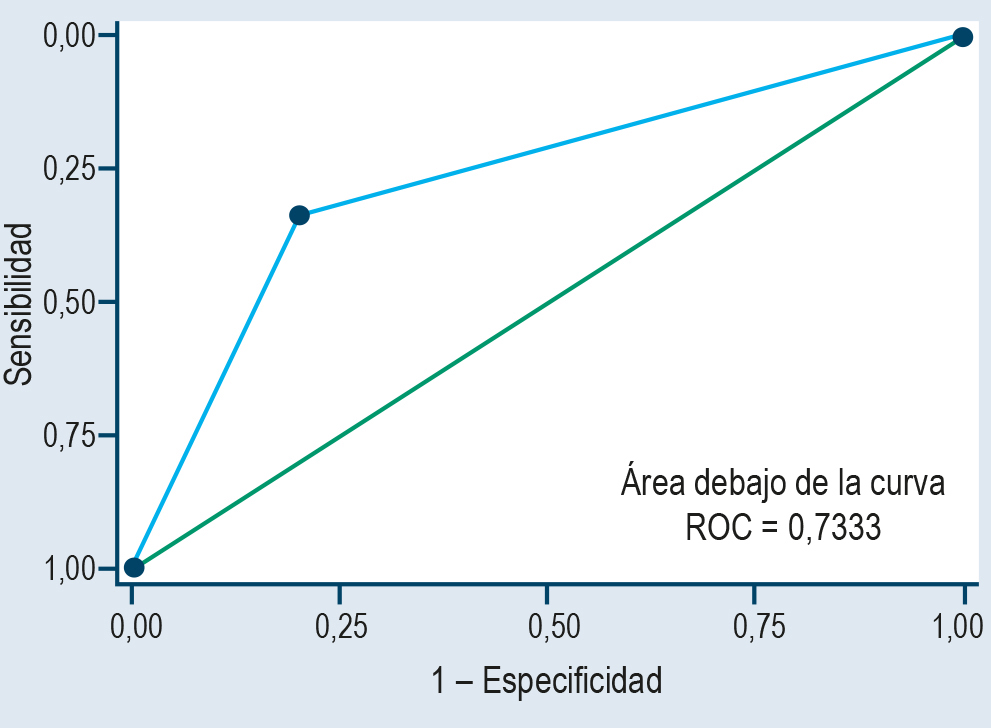
Results: A total of 86 patients were included in the final analysis. Of these, 80.2% (n = 69) were female, with a mean age of 63 years (± 9.83). The PDR with CAD EYE was 58.1%, whereas the ADR was 38.4% The concordance rate between AI and histopathology for lesions classified as neoplastic or hyperplastic was 73.13%. AI-based categorization of colorectal lesions as neoplastic demonstrated a sensitivity of 78.8% and specificity of 83.1%, with an area under the curve (AUC) of 0.73 (95% confidence interval [CI]: 0.686–0.882). Compared with the ADR previously reported by two of the study authors, the use of AI increased adenoma detection by more than 10%.
Conclusion: This is the first study in Colombia evaluating the use of real-time AI software during colonoscopy, demonstrating a significant improvement in both ADR and PDR. Current evidence, alongside the findings of this study, indicates a promising discriminative ability for AI-assisted characterization of colonic polyps.
Downloads
References
Xi Y, Xu P. Global colorectal cancer burden in 2020 and projections to 2040. Transl Oncol. 2021;14(10):101174. https://doi.org/10.1016/j.tranon.2021.101174
Kamitani Y, Nonaka K, Isomoto H. Current Status and Future Perspectives of Artificial Intelligence in Colonoscopy. J Clin Med. 2022;11(10):2923. https://doi.org/10.3390/jcm11102923
Keswani RN, Crockett SD, Calderwood AH. AGA Clinical Practice Update on Strategies to Improve Quality of Screening and Surveillance Colonoscopy: Expert Review. Gastroenterology. 2021;161(2):701-711. https://doi.org/10.1053/j.gastro.2021.05.041
Ahn SB, Han DS, Bae JH, Byun TJ, Kim JP, Eun CS. The Miss Rate for Colorectal Adenoma Determined by Quality-Adjusted, Back-to-Back Colonoscopies. Gut Liver. 2012;6(1):64-70. https://doi.org/10.5009/gnl.2012.6.1.64
Gómez-Zuleta MA, Cano-Rosales DF, Bravo Higuera DF, Ruano-Balseca JA, Romero-Castro E. Detección automática de pólipos colorrectales con técnicas de inteligencia artificial. Rev Colomb Gastroenterol. 2021;36(1):7-17. https://doi.org/10.22516/25007440.471
Xu L, He X, Zhou J, Zhang J, Mao X, Ye G, et al. Artificial intelligence-assisted colonoscopy: A prospective, multicenter, randomized controlled trial of polyp detection. Cancer Med. 2021;10(20):7184-7193. https://doi.org/10.1002/cam4.4261
Hassan C, Spadaccini M, Iannone A, Maselli R, Jovani M, Chandrasekar VT, et al. Performance of artificial intelligence in colonoscopy for adenoma and polyp detection: a systematic review and meta-analysis. Gastrointest Endosc. 2021;93(1):77-85.e6. https://doi.org/10.1016/j.gie.2020.06.059
Rex DK, Anderson JC, Butterly LF, Day LW, Dominitz JA, Kaltenbach T, et al. Quality indicators for colonoscopy. Gastrointest Endosc. 2024;100(3):352-381. https://doi.org/10.1016/j.gie.2024.04.2905
Corley DA, Jensen CD, Marks AR, Zhao WK, Lee JK, Doubeni CA, et al. Adenoma detection rate and risk of colorectal cancer and death. N Engl J Med. 2014;370(14):1298-306. https://doi.org/10.1056/NEJMoa1309086
Rex DK, Schoenfeld PS, Cohen J, Pike IM, Adler DG, Fennerty MB, et al. Quality indicators for colonoscopy. Gastrointest Endosc. 2015:81(1):31-53. https://doi.org/10.1016/j.gie.2014.07.058
Repici A, Spadaccini M, Antonelli G, Correale L, Maselli R, Galtieri PA, et al. Artificial intelligence and colonoscopy experience: lessons from two randomised trials. Gut. 2022;71(4):757-765. https://doi.org/10.1136/gutjnl-2021-324471
Repici A, Badalamenti M, Maselli R, Correale L, Radaelli F, Rondonotti E, et al. Efficacy of Real-Time Computer-Aided Detection of Colorectal Neoplasia in a Randomized Trial. Gastroenterology. 2020;159(2):512-520.e7. https://doi.org/10.1053/j.gastro.2020.04.062
Huang D, Shen J, Hong J, Zhang Y, Dai S, Du N, et al. Effect of artificial intelligence-aided colonoscopy for adenoma and polyp detection: a meta-analysis of randomized clinical trials. Int J Colorectal Dis. 2022;37(3):495-506. https://doi.org/10.1007/s00384-021-04062-x
Schöler J, Alavanja M, de Lange T, Yamamoto S, Hedenström P, Varkey J. Impact of AI-aided colonoscopy in clinical practice: a prospective randomised controlled trial. BMJ Open Gastroenterol. 2024;11(1):e001247. https://doi.org/10.1136/bmjgast-2023-001247
Mohan BP, Facciorusso A, Khan SR, Chandan S, Kassab LL, Gkolfakis P, et al. Real-time computer aided colonoscopy versus standard colonoscopy for improving adenoma detection rate: A meta-analysis of randomized-controlled trials. EClinicalMedicine. 2020;29-30:100622. https://doi.org/10.1016/j.eclinm.2020.100622
Aponte Martín DM, Corso Bernal CL, Aponte Aparicio MV, Sabbagh Sanvicente LC. Mejoría de la preparación de colonoscopia usando tecnologías de la información y comunicación (TIC), ensayo clínico aleatorizado. Rev Colomb Gastroenterol. 2024:39(1);51-8. https://doi.org/10.22516/25007440.1092
Downloads
Published
How to Cite
Issue
Section
License
Copyright (c) 2025 Revista colombiana de Gastroenterología

This work is licensed under a Creative Commons Attribution-NonCommercial-NoDerivatives 4.0 International License.
Aquellos autores/as que tengan publicaciones con esta revista, aceptan los términos siguientes:
Los autores/as ceden sus derechos de autor y garantizarán a la revista el derecho de primera publicación de su obra, el cuál estará simultáneamente sujeto a la Licencia de reconocimiento de Creative Commons que permite a terceros compartir la obra siempre que se indique su autor y su primera publicación en esta revista.
Los contenidos están protegidos bajo una licencia de Creative Commons Reconocimiento-NoComercial-SinObraDerivada 4.0 Internacional.