Incarcerated Littre’s Hernia: A Case Report
DOI:
https://doi.org/10.22516/25007440.1274Keywords:
Inguinal hernia, ileal diverticulum, inguinal canal, acute abdomen, indirect inguinal herniaAbstract
Introduction: Meckel’s diverticulum is a congenital anomaly of the gastrointestinal tract. It is usually asymptomatic and occurs in approximately 0.6% to 4% of individuals. A Littre’s hernia is defined as the presence of a Meckel’s diverticulum within a hernia sac. Littre’s hernias can occur at various anatomical sites, including inguinal, femoral, and umbilical locations.
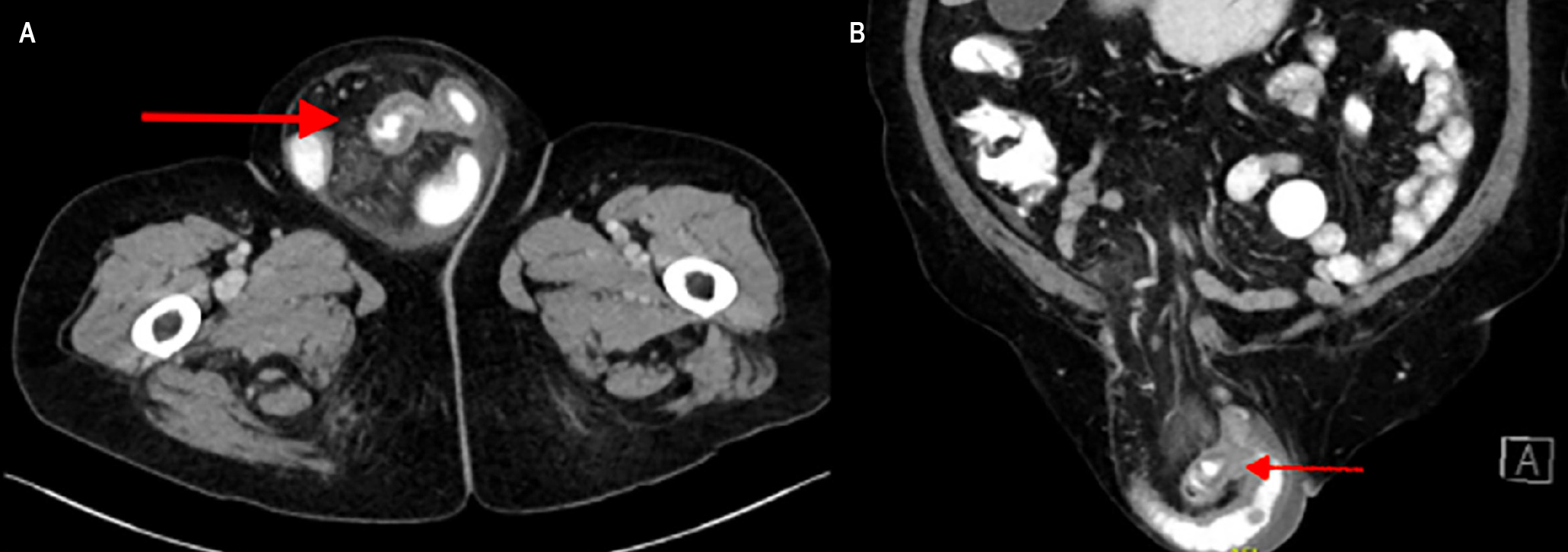
Clinical Case: An 80-year-old female presented to the emergency department of a quaternary care center with a 14-hour history of symptoms compatible with a right inguinal hernia (indirect) incarcerated NYHUS IIIB, containing a narrow-necked Meckel’s diverticulum, constituting a mixed Littre’s hernia.
Results: Few cases of Littre’s hernias have been reported in the literature, with an approximate incidence of 1% among patients with a Meckel’s diverticulum. Diagnosis is typically intraoperative, with clinical manifestations including abdominal pain and distension. Complications such as obstruction and incarceration occur similarly to other abdominal wall hernias. Management is based on both hernia repair and resection of the diverticulum.
Conclusions: To date, no standardized consensus exists regarding the surgical approach for this condition, particularly when it is an incidental finding. Surgical technique may depend on multiple factors, making knowledge of anatomy, clinical presentation, and diagnostic imaging crucial for timely diagnosis and treatment of Littre’s hernia.
Downloads
References
Usman A, Rashid MH, Ghaffar U, Farooque U, Shabbir A. Littré’s Hernia: A Rare Intraoperative Finding. Cureus. 2020;12(10):e11065. https://doi.org/10.7759/cureus.11065
Puentes JA, Salcedo JD, Luna DR. Divertículo de Meckel en el adulto mayor: una causa de sangrado digestivo revisión de la literatura y reporte de un caso. Rev Colomb Cir. 2015;30(2):151-5.
https://doi.org/10.30944/20117582.325
Sánchez-Castellanos ME, Sandoval-Tress C, Hernández-Torres M. Persistencia del conducto onfalomesentérico. Diagnóstico diferencial de granuloma umbilical en la infancia. Actas Dermo-Sifiliográficas. 2006;97(6):404-5. https://doi.org/10.1016/S0001-7310(06)73429-9
Malling B, Karlsen AA, Hern J. Littre Hernia: A Rare Case of an Incarcerated Meckel’s Diverticulum. Ultrasound Int Open. 2017;3(2):E91-E92. https://doi.org/10.1055/s-0043-102179
Bains HK, Agostinho N, Hamilton AE, Byrne C. What is in the sac? Littré hernia. ANZ J Surg. 2020;90(5):896-8. https://doi.org/10.1111/ans.15353
Schizas D, Katsaros I, Tsapralis D, Moris D, Michalinos A, Tsilimigras DI, et al. Littre’s hernia: a systematic review of the literature. Hernia. 2019;23(1):125-30. https://doi.org/10.1007/s10029-018-1867-0
Racy M, Ramesh S. Littré meets de garengeot: meckel’s diverticulum and appendix in a femoral hernia. Ann R Coll Surg Engl. 2013;95(6):e97-8. https://doi.org/10.1308/003588413X13629960047399
Lamb R, Kahlon A, Sukumar S, Layton B. Small bowel diverticulosis: imaging appearances, complications, and pitfalls. Clin Radiol. 2022;77(4):264-273. https://doi.org/10.1016/j.crad.2021.12.003
Essobiyou TB, Pali E, Keheou AP, Issa M, Dosseh ED. Unusual form of inguinal hernia: A case report of Littré’s hernia strangled. Int J Surg Case Rep. 2022:98:107570. https://doi.org/10.1016/j.ijscr.2022.107570
Keese D, Rolle U, Gfroerer S, Fiegel H. Symptomatic Meckel’s Diverticulum in Pediatric Patients—Case Reports and Systematic Review of the Literature. Front Pediatr. 2019;7:267. https://doi.org/10.3389/fped.2019.00267
Park JJ, Wolff BG, Tollefson MK, Walsh EE, Larson DR. Meckel Diverticulum: The Mayo Clinic Experience With 1476 Patients (1950–2002). Ann Surg. 2005;241(3):529-33. https://doi.org/10.1097/01.sla.0000154270.14308.5f
Downloads
Published
How to Cite
Issue
Section
License
Copyright (c) 2025 Revista colombiana de Gastroenterología

This work is licensed under a Creative Commons Attribution-NonCommercial-NoDerivatives 4.0 International License.
Aquellos autores/as que tengan publicaciones con esta revista, aceptan los términos siguientes:
Los autores/as ceden sus derechos de autor y garantizarán a la revista el derecho de primera publicación de su obra, el cuál estará simultáneamente sujeto a la Licencia de reconocimiento de Creative Commons que permite a terceros compartir la obra siempre que se indique su autor y su primera publicación en esta revista.
Los contenidos están protegidos bajo una licencia de Creative Commons Reconocimiento-NoComercial-SinObraDerivada 4.0 Internacional.