Inverted-Growth Buschke-Löwenstein Tumor: A Case Report with Therapeutic Proposal
DOI:
https://doi.org/10.22516/25007440.1258Keywords:
Condyloma acuminatum, human papillomavirus,, verrucous carcinoma, anoscopy, anal cancer, anal neoplasmsAbstract
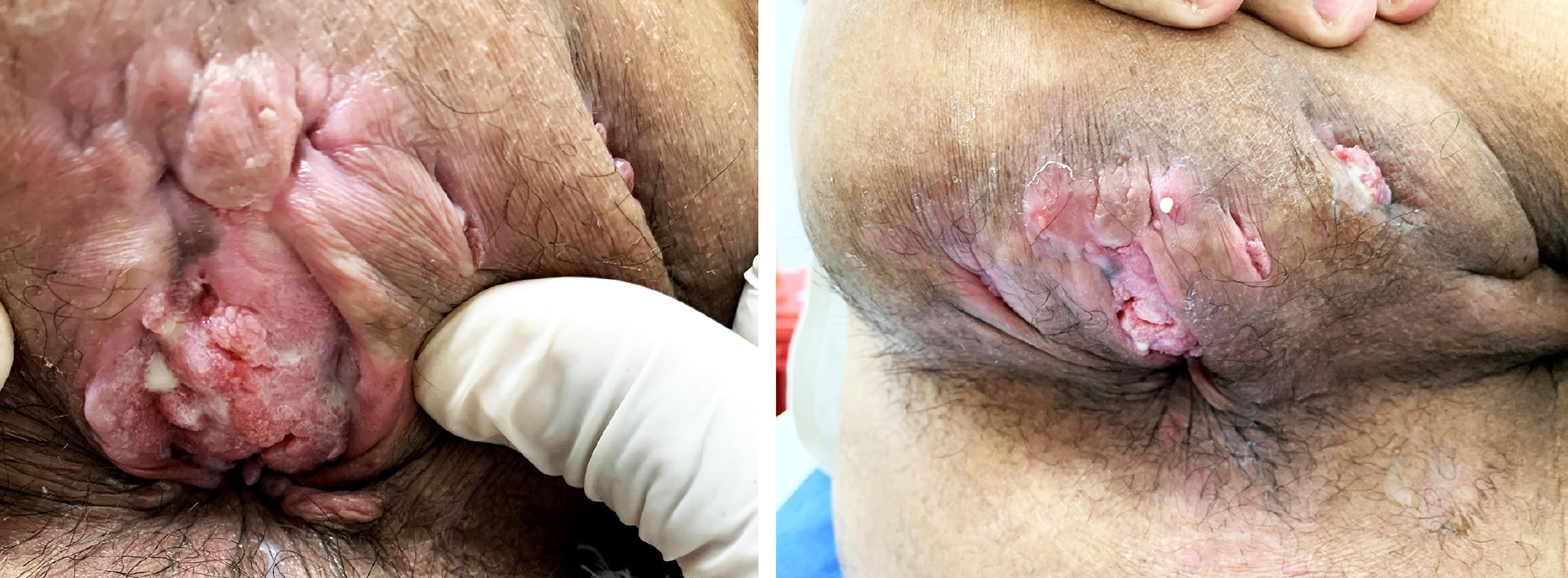
The Buschke-Löwenstein tumor (BLT) is a type of giant epithelial tumor typically characterized by a broad base, infiltrative potential, and local tissue destruction. As a result, recurrences are common, which confers a certain degree of malignant potential. From a histopathological standpoint, it is composed of hyperplastic epithelium, minimal atypia, and well-differentiated tissue with hyperkeratosis, parakeratosis, and the presence of koilocytes. This finding is a hallmark of human papillomavirus (HPV) infection at the cellular level, along with granular changes and mitotic activity in the basal layer. This article describes a rare variant with inverted growth and infiltration of the anal and perianal tissues, associated with a clinical presentation of anal fissures and fistulas. A therapeutic proposal is also discussed. The case involves a 35-year-old male from Bello, Antioquia, who presented to our institution with a 4-year history of perianal openings with purulent discharge, pain, and bleeding. A contrast-enhanced pelvic MRI revealed infiltration of the anal, perianal, and adipose tissues by condylomatous lesions with displacement of adjacent structures. A medical management protocol developed at the Instituto de Coloproctología (ICO) in Medellín, Colombia, was implemented and complemented with surgical treatment.
Downloads
References
Gomez da Cruz GM. Nomes que Fazem a História da Coloproctologia. Rev bras Coloproct. 2009;29(2):256-265.
Casagrande J, Braga T, Sidney R, Nadal M. Buschke- Lowenstein tumor: identification of HPV type 6 and 11. An Bras Dermatol. 2012;87(1):131-4. https://doi.org/10.1590/S0365-05962012000100018
Rahman S, Pierce Campbell CM, Waterboer T, Rollison DE, Ingles DJ, Torres BN, et al. Seroprevalence of cutaneous human papillomaviruses (HPVs) among men in the multinational HPV Infection in Men study. J Gen Virol. 2016;97(12):3291-3301. https://doi.org/10.1099/jgv.0.000620
Antonsson A, Green AC, Mallitt KA, O’Rourke PK, Pandeya N, Pawlita M, et al. Prevalence and stability of antibodies to 37 human papillomavirus types--a population-based longitudinal study. Virology. 2010;407(1):26-32. https://doi.org/10.1016/j.virol.2010.07.046
Ruel J, Ko HM, Roda G, Patil N, Zhang D, Jharap B, et al. Anal Neoplasia in Inflammatory Bowel Disease Is Associated With HPV and Perianal Disease. Clin Transl Gastroenterol. 2016;7(3):e148. https://doi.org/10.1038/ctg.2016.8
Nyitray AG, Carvalho da Silva RJ, Baggio ML, Lu B, Smith D, Abrahamsen M, et al. Age-specific prevalence of and risk factors for anal human papillomavirus (HPV) among men who have sex with women and men who have sex with men: the HPV in men (HIM) study. J Infect Dis. 2011;203(1):49-57. https://doi.org/10.1093/infdis/jiq021
Limoges-Gonzalez M, Al-Juburi A. Anal Intraepithelial Neoplasia. J Clin Gastroenterol. 2017;51(3):203-207. https://doi.org/10.1097/MCG.0000000000000721
Roberts JR, Siekas LL, Kaz AM. Anal intraepithelial neoplasia: A review of diagnosis and management. World J Gastrointest Oncol. 2017;9(2):50-61. https://doi.org/10.4251/wjgo.v9.i2.50
McBride AA. Human papillomaviruses: diversity, infection and host interactions. Nat Rev Microbiol. 2022;20(2):95-108. https://doi.org/10.1038/s41579-021-00617-5
Poggio JL. Premalignant lesions of the anal canal and squamous cell carcinoma of the anal canal. Clin Colon Rectal Surg. 2011;24(3):177-92. https://doi.org/10.1055/s-0031-1286002
Steffen C. The men behind the eponym - Abraham Buschke and Ludwig Lowenstein: giant condyloma (Buschke-Loewenstein). Am J Dermatopathol. 2006;28(6):526-36. https://doi.org/10.1097/01.dad.0000211528.87928.a8
Purzycka-Bohdan D, Nowicki RJ, Herms F, Casanova JL, Fouéré S, Béziat V. The Pathogenesis of Giant Condyloma Acuminatum (Buschke-Lowenstein Tumor): An Overview. Int J Mol Sci. 2022;23(9):4547. https://doi.org/10.3390/ijms23094547
Chao MW, Gibbs P. Squamous cell carcinoma arising in a giant condyloma acuminatum (Buschke-Lowenstein tumour). Asian J Surg. 2005;28(3):238-40. https://doi.org/10.1016/S1015-9584(09)60352-3
Handisurya A, Rieger A, Bago-Horvath Z, Schellenbacher C, Bankier A, Salat A, et al. Rapid progression of an anal Buschke-Lowenstein tumour into a metastasising squamous cell carcinoma in an HIV-infected patient. Sex Transm Infect. 2009;85(4):261-3. https://doi.org/10.1136/sti.2008.034959
Chu QD, Vezeridis MP, Libbey NP, Wanebo HJ. Giant condyloma acuminatum (Buschke-Lowenstein tumor) of the anorectal and perianal regions. Analysis of 42 cases. Dis Colon Rectum. 1994;37(9):950-7. https://doi.org/10.1007/BF02052606
Diani M, Boneschi V, Ramoni S, Gadda F, Del Gobbo A, Cusini M. Rapidly Invasive Buschke-Löwenstein Tumor Associated With Human Papillomavirus Types 6 and 52. Sex Transm Dis. 2015;42(10):547-8. https://doi.org/10.1097/OLQ.0000000000000346
Yiu ZZ, Ali FR, Wilson MS, Mowatt D, Lyon CC. Giant condylomata acuminata of Buschke and Lowenstein: A peristomal variant. Int J Surg Case Rep. 2014;5(12):1014-7. https://doi.org/10.1016/j.ijscr.2014.10.063
Bastola S, Halalau A, Kc O, Adhikari A. A Gigantic Anal Mass: Buschke-Löwenstein Tumor in a Patient with Controlled HIV Infection with Fatal Outcome. Case Rep Infect Dis. 2018;2018:7267213. https://doi.org/10.1155/2018/7267213
Nieves-Condoy JF, Acuña-Pinzón CL, Chavarría-Chavira JL, Hinojosa-Ugarte D, Zúñiga-Vázquez LA. Giant Condyloma Acuminata (Buschke-Lowenstein Tumor): Review of an Unusual Disease and Difficult to Manage. Infect Dis Obstet Gynecol. 2021;2021:9919446. https://doi.org/10.1155/2021/9919446
Downloads
Published
How to Cite
Issue
Section
License
Copyright (c) 2025 Revista colombiana de Gastroenterología

This work is licensed under a Creative Commons Attribution-NonCommercial-NoDerivatives 4.0 International License.
Aquellos autores/as que tengan publicaciones con esta revista, aceptan los términos siguientes:
Los autores/as ceden sus derechos de autor y garantizarán a la revista el derecho de primera publicación de su obra, el cuál estará simultáneamente sujeto a la Licencia de reconocimiento de Creative Commons que permite a terceros compartir la obra siempre que se indique su autor y su primera publicación en esta revista.
Los contenidos están protegidos bajo una licencia de Creative Commons Reconocimiento-NoComercial-SinObraDerivada 4.0 Internacional.