Pancreatic Ascites in a Patient with Severe Acute Pancreatitis: An Unusual Case
DOI:
https://doi.org/10.22516/25007440.1257Keywords:
Pancreatitis, ascites, biliary tract, pancreatic duct, surgeryAbstract
Background: Pancreatic ascites is an uncommon clinical entity resulting from the accumulation of pancreatic fluid in the peritoneal cavity. It is caused by the leakage from a pancreatic pseudocyst or injury to the pancreatic duct. Diagnosis is based on elevated amylase levels in ascitic fluid (greater than 1000 U/L) and protein levels above 2.5 g/dL. Chronic pancreatitis (83%), acute pancreatitis (8.6%), and trauma (3.6%) are the most common causes of pancreatic duct disruption.
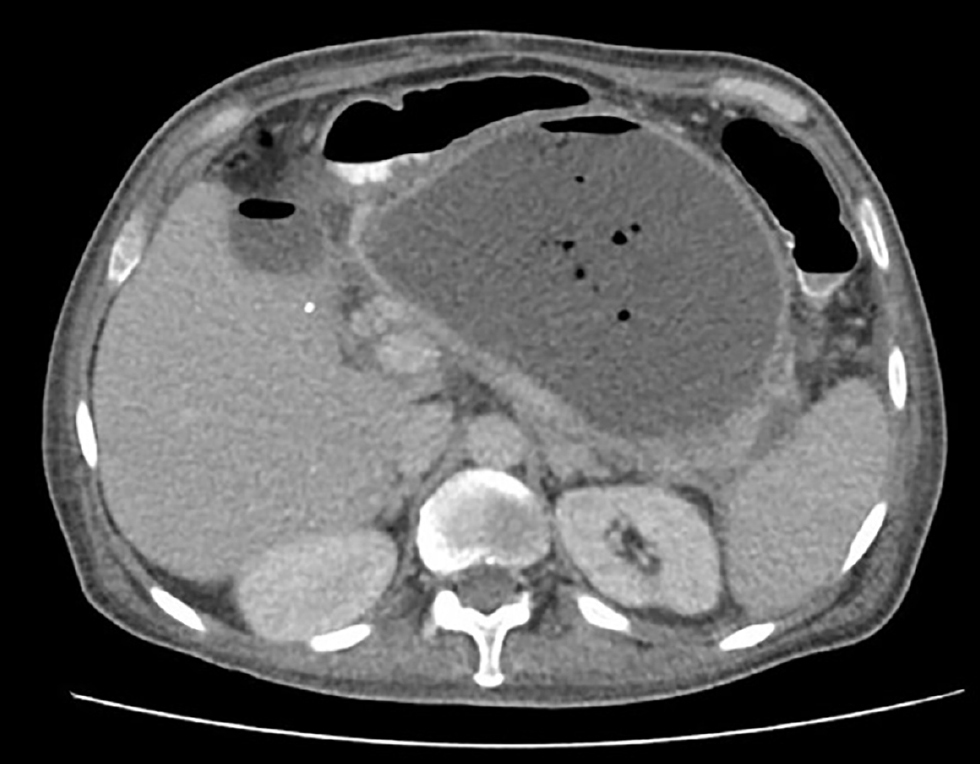
Case Summary: We report the case of a 59-year-old male patient referred to our institution for severe acute pancreatitis of biliary etiology, complicated by infected encapsulated necrosis. Necrosis extended through the left paracolic gutter to the pelvis and left inguinal region, with additional subcapsular hepatic fluid collections involving segments VI and VIII, requiring both endoscopic and percutaneous management. During clinical follow-up, the patient developed grade 3 ascites, for which he underwent two diagnostic and therapeutic paracenteses. Analysis of the fluid was consistent with pancreatic ascites.
Conclusions: Patients with pancreatic ascites represent a small and heterogeneous population. Early detection is crucial due to the prognostic and therapeutic implications of this finding. Mild cases typically respond to medical management, while more severe cases require endoscopic treatment, with surgical intervention being rarely necessary.
Downloads
References
Bradley EL, Gonzalez AC, Clements JL Jr. Acute pancreatic pseudocysts: incidence and implications. Ann Surg. 1976;184(6):734-7. https://doi.org/10.1097/00000658-197612000-00013
He WH, Xion ZJ, Zhu Y, Xia L, Zhu Y, Liu P, et al. Percutaneous Drainage Versus Peritoneal Lavage for Pancreatic Ascites in Severe Acute Pancreatitis: A Prospective Randomized Trial. Pancreas. 2019;48(3):343-349. https://doi.org/10.1097/MPA.000000000000125
Song Z, Zhu Q, Zhang Y, Yan X, Pan X. Ascites volume quantification via abdominal CT: A novel approach to predict severity in acute pancreatitis. Medical Science Monitor. 2023;29:e940783. https://doi.org/10.12659/MSM.940783
Bush N, Rana SS. Ascites in acute pancreatitis: Clinical implications and management. Digestive Diseases and Sciences. 2021;67(6):1987-93. https://doi.org/10.1007/s10620-021-07063-6
Sileo AV, Chawla SK, LoPresti PA. Pancreatic ascites: Diagnostic importance of ascitic lipase. The American Journal of Digestive Diseases. 1975;20(12):1110-4. https://doi.org/10.1007/BF01070753
Zhang F, Wang HX, Wang X, Huang WF. Pancreatic fistula presenting with bloody ascites and acute peritonitis in a chronic pancreatitis patient: a case report. J Xiangya Med 2021;6:34. https://doi.org/10.21037/jxym-21-33
Karagyozov P, Tishkov I, Boeva I, Plachkov I. Endoscopic ultrasound-guided pancreaticogastrostomy as a rescue therapy for pancreatic ascites after failed ERCP. Endoscopy. 2021;53(3):E104-E105. https://doi.org/10.1055/a-1207-0191
Zeng Q-X, Wu Z-H, Huang D-L, Huang Y-S, Zhong H-J. Association between Ascites and clinical findings in patients with acute pancreatitis: A retrospective study. Medical Science Monitor. 2021;27:e933196. https://doi.org/10.12659/MSM.933196
Larsen M, Kozarek R. Management of pancreatic ductal leaks and fistulae. J Gastroenterol Hepatol. 2014;29(7):1360-70. https://doi.org/10.1111/jgh.12574
Jang JW, Kim MH, Oh D, Cho DH, Song TJ, Park DH, et al. Factors and outcomes associated with pancreatic duct disruption in patients with acute necrotizing pancreatitis. Pancreatology. 2016;16(6):958-965. https://doi.org/10.1016/j.pan.2016.09.009
Oey RC, van Buuren HR, de Man RA. The diagnostic work-up in patients with ascites: current guidelines and future prospects. Neth J Med. 2016;74(8):330-335.
He WH, Xion ZJ, Zhu Y, Xia L, Zhu Y, Liu P, et al. Percutaneous Drainage Versus Peritoneal Lavage for Pancreatic Ascites in Severe Acute Pancreatitis: A Prospective Randomized Trial. Pancreas. 2019;48(3):343-349. https://doi.org/10.1097/MPA.0000000000001251
Kanneganti K, Srikakarlapudi S, Acharya B, Sindhaghatta V, Chilimuri S. Successful Management of Pancreatic Ascites with both Conservative Management and Pancreatic Duct Stenting. Gastroenterol Res. 2009;2(4):245-7. https://doi.org/10.4021/gr2009.08.1306
Castaño-Llano R, Artifon EL. Intervencionismo endoscópico en la pancreatitis crónica. Rev Col Gastroenterol. 2019;34(1):38-51. https://doi.org/10.22516/25007440.354
Ramia JM, Fabregat J, Pérez-Miranda M. Síndrome del ducto pancreático desconectado [Disconnected pancreatic duct syndrome]. Cir Esp. 2014;92(1):4-10. Spanish. https://doi.org/10.1016/j.ciresp.2013.02.024
Varadarajulu S, Noone TC, Tutuian R, Hawes RH, Cotton PB. Predictors of outcome in pancreatic duct disruption managed by endoscopic transpapillary stent placement. Gastrointest Endosc. 2005;61(4):568-75. https://doi.org/10.1016/S0016-5107(04)02832-9
Strand DS, Law RJ, Yang D, Elmunzer BJ. AGA Clinical Practice Update on the Endoscopic Approach to Recurrent Acute and Chronic Pancreatitis: Expert Review. Gastroenterology. 2022;163(4):1107-1114. https://doi.org/10.1053/j.gastro.2022.07.079
Dumonceau JM, Delhaye M, Tringali A, Dominguez-Munoz JE, Poley JW, Arvanitaki M, et al. Endoscopic treatment of chronic pancreatitis: European Society of Gastrointestinal Endoscopy (ESGE) Clinical Guideline. Endoscopy. 2012;44(8):784-800. https://doi.org/10.1055/s-0032-1309840
Dominguez-Munoz JE, Drewes AM, Lindkvist B, Ewald N, Czakó L, Rosendahl J, et al; HaPanEU/UEG Working Group. Recommendations from the United European Gastroenterology evidence-based guidelines for the diagnosis and therapy of chronic pancreatitis. Pancreatology. 2018;18(8):847-854. https://doi.org/10.1016/j.pan.2018.09.016
Löhr JM, Dominguez-Munoz E, Rosendahl J, Besselink M, Mayerle J, Lerch MM, et al; HaPanEU/UEG Working Group. United European Gastroenterology evidence-based guidelines for the diagnosis and therapy of chronic pancreatitis (HaPanEU). United European Gastroenterol J. 2017;5(2):153-199. https://doi.org/10.1177/2050640616684695
Downloads
Published
How to Cite
Issue
Section
License
Copyright (c) 2025 Revista colombiana de Gastroenterología

This work is licensed under a Creative Commons Attribution-NonCommercial-NoDerivatives 4.0 International License.
Aquellos autores/as que tengan publicaciones con esta revista, aceptan los términos siguientes:
Los autores/as ceden sus derechos de autor y garantizarán a la revista el derecho de primera publicación de su obra, el cuál estará simultáneamente sujeto a la Licencia de reconocimiento de Creative Commons que permite a terceros compartir la obra siempre que se indique su autor y su primera publicación en esta revista.
Los contenidos están protegidos bajo una licencia de Creative Commons Reconocimiento-NoComercial-SinObraDerivada 4.0 Internacional.