Idiopathic Adult Ductopenia: Case report
DOI:
https://doi.org/10.22516/25007440.1204Keywords:
Bile canaliculi, cholestasis intrahepatic, biliary tract diseases, adult, jaundiceAbstract
Introduction: Intrahepatic cholestatic ductomas can be associated with an inflammatory process that leads to the destruction of small or medium caliber biliary canaliculi with their subsequent disappearance. Adult idiopathic ductopenia is a diagnosis of exclusion characterized by the destruction of at least 50% of the portal ducts and requires the exclusion of autoimmune and mechanical causes, among others.
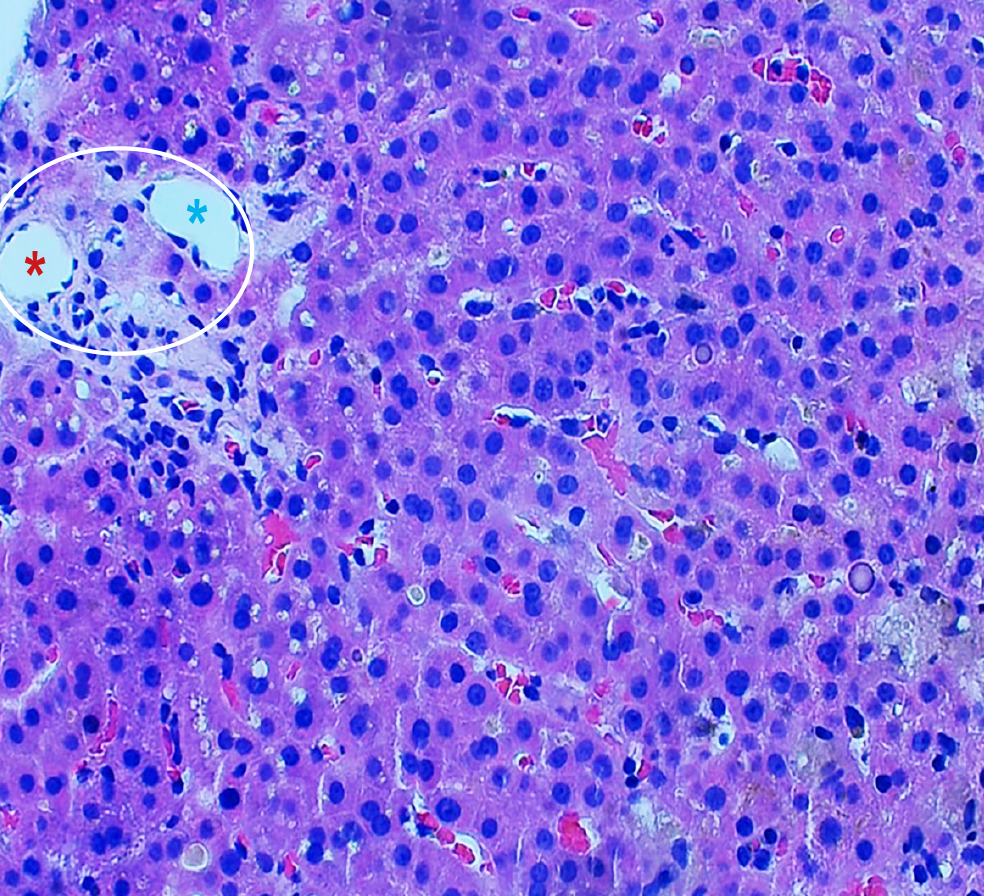
Case Report: 23-year-old patient with no pathologic history who presented with progressive jaundice and incoercible pruritus. Cholangioresonance was performed, which ruled out mechanical obstruction or images suggestive of primary sclerosing cholangitis. Studies of infectious etiology were negative and serum levels of antibodies associated with destruction of biliary canaliculi were within normal ranges. Given the persistence of jaundice of unclear cause, it was decided to perform a liver biopsy which reported loss of ducts in the portal triads with focal destruction.
Discussion: After analyzing the requested studies, the presentation and course of the disease, the diagnosis of adult idiopathic ductopenia was considered, and management with ursodeoxycholic acid was started, achieving gradual improvement and a follow-up appointment was made.
Conclusion: The diagnosis of ductopenia was made after having negative serological studies for infectious/inflammatory causes, through a negative cholangioresonance and a liver biopsy as as reported in the literature. Excluding secondary causes of ductopenia.
Downloads
References
Ludwig J. Idiopathic adulthood ductopenia: an update. Mayo Clin Proc. 1998;73(3):285-91. https://doi.org/10.4065/73.3.285
Khanlou H, Sass D, Rothstein K, Manzarbeitia C, Reich D, Jacobson L, et al. Idiopathic adulthood ductopenia: case report and review of the literature. Arch Intern Med. 2000;160(7):1033-6. https://doi.org/10.1001/ARCHINTE.160.7.1033
Timoniuk CI, Acosta M, Vizcaino AA, Panzardi MY. Ductopenia idiopática del adulto. Servicio de Cirugía Del Hospital “Dr. José R. Vidal”. Revista de Posgrado de la Vía Cátedra de Medicina. 2008;180:7-11.
Kaplan MM. Primary biliary cirrhosis. N Engl J Med. 1996;335(21):1570-80. https://doi.org/10.1056/NEJM199611213352107
Kim WR, Ludwig J, Lindor KD. Variant forms of cholestatic diseases involving small bile ducts in adults. Am J Gastroenterol. 2000;95(5):1130-8. https://doi.org/10.1111/j.1572-0241.2000.01999.x
Burak KW, Pearson DC, Swain MG, Kelly J, Urbanski SJ, Bridges RJ. Familial idiopathic adulthood ductopenia: a report of five cases in three generations. J Hepatol. 2000;32(1):159-63. https://doi.org/10.1016/S0168-8278(00)80203-2
Douglass KM, Willner IR, Glenn DJ, Jones RM. Idiopathic Adulthood Ductopenia Causing Cirrhosis. ACG Case Rep J. 2020;7(3):e00349. https://doi.org/10.14309/CRJ.0000000000000349
Park BC, Park SM, Choi EY, Chae HB, Yoon SJ, Sung R, et al. A case of idiopathic adulthood ductopenia. Korean J Intern Med. 2009;24(3):270-3. https://doi.org/10.3904/KJIM.2009.24.3.270
Peniche-Moquel P, Pérez-Hernández JL, Cordova J. Chronic cholestasis in a 20-year-old young man: a case of idiopathic adulthood ductopenia. Gastroenterol Hepatol. 2013;36(10):628-30. https://doi.org/10.1016/J.GASTROHEP.2013.07.003
Rios R, Herrero JI, Quiroga J, Sangro B, Sola I, Pardo F, et al. Idiopathic adulthood ductopenia: long-term follow-up after liver transplantation. Dig Dis Sci. 2001;46(7):1420-3. https://doi.org/10.1023/A:1010679502324
Ludwig J, Wiesner RH, LaRusso NF. Idiopathic adulthood ductopenia. A cause of chronic cholestatic liver disease and biliary cirrhosis. J Hepatol. 1988;7(2):193-9. https://doi.org/10.1016/S0168-8278(88)80482-3
Downloads
Published
How to Cite
Issue
Section
License
Copyright (c) 2025 Revista colombiana de Gastroenterología

This work is licensed under a Creative Commons Attribution-NonCommercial-NoDerivatives 4.0 International License.
Aquellos autores/as que tengan publicaciones con esta revista, aceptan los términos siguientes:
Los autores/as ceden sus derechos de autor y garantizarán a la revista el derecho de primera publicación de su obra, el cuál estará simultáneamente sujeto a la Licencia de reconocimiento de Creative Commons que permite a terceros compartir la obra siempre que se indique su autor y su primera publicación en esta revista.
Los contenidos están protegidos bajo una licencia de Creative Commons Reconocimiento-NoComercial-SinObraDerivada 4.0 Internacional.