Acquired Superior Mesenteric Artery Syndrome: A Case Report with Associated Mortality
DOI:
https://doi.org/10.22516/25007440.1196Keywords:
Superior Mesenteric Artery Syndrome, intestinal obstruction, weight loss, breast neoplasm, duodenal obstructionAbstract
Introduction: Superior Mesenteric Artery Syndrome (SMAS) is a rare vascular-origin intestinal obstruction affecting the third portion of the duodenum. It is often underdiagnosed due to its multiple confounding factors, leading to delays in diagnosis and a high morbidity and mortality rate. The primary underlying mechanism is significant weight loss, and it is more commonly seen in young women. Current treatment approaches include either medical management or minimally invasive surgery.
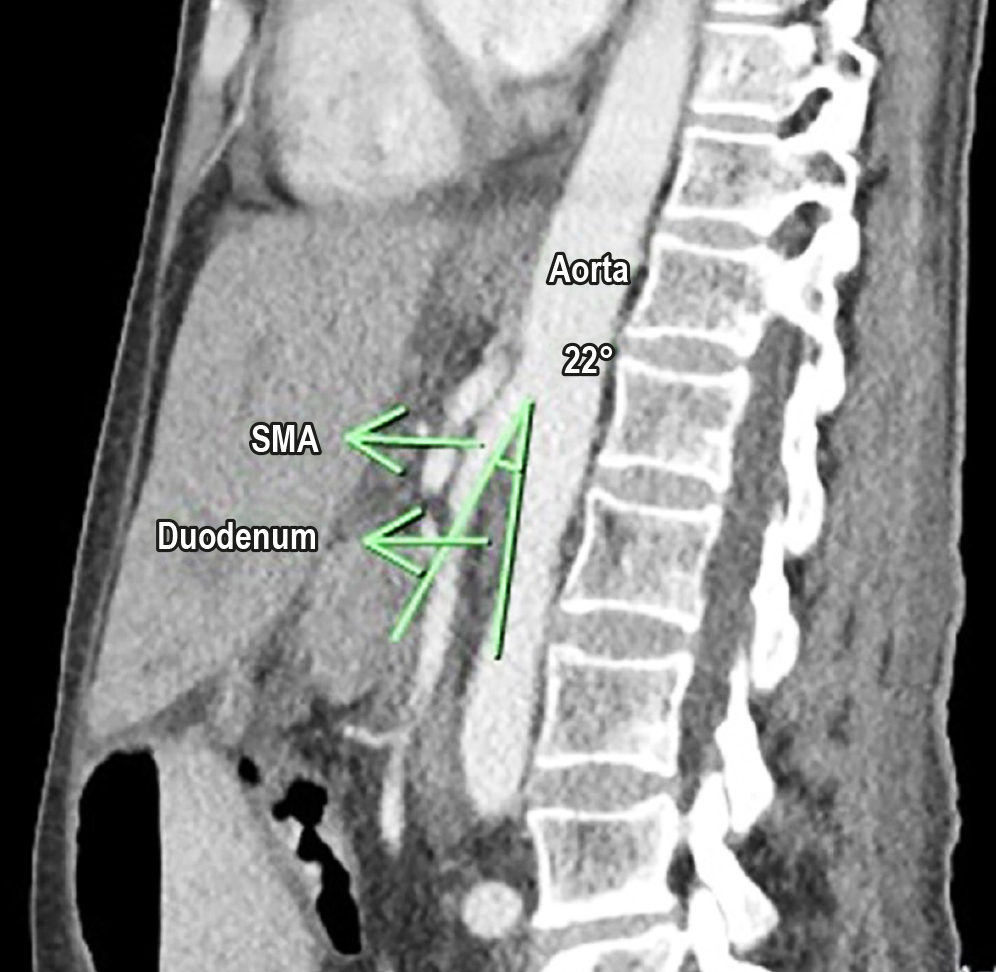
Case Presentation: We present the case of a 61-year-old woman with a six-month history of insidious abdominal pain and recurrent episodes of vomiting, accompanied by severe weight loss. Imaging studies confirmed a diagnosis of SMAS, which was secondary to tumor recurrence in metastatic breast cancer. Conservative management was initiated; however, the patient ultimately succumbed to infectious complications.
Conclusions: SMAS is a rare and challenging condition to diagnose. Various underlying factors contribute to significant weight loss, which is central to its pathophysiology. Computed tomography (CT) and magnetic resonance imaging (MRI) are the preferred diagnostic modalities. While conservative management remains the first-line treatment, it is associated with a high recurrence rate. Surgical intervention, though an option, carries substantial morbidity risks due to the complexity of the procedure.
Downloads
References
Oka A, Awoniyi M, Hasegawa N, Yoshida Y, Tobita H, Ishimura N, et al. Superior mesenteric artery syndrome: Diagnosis and management. World J Clin cases. 2023;11(15):3369-84. https://doi.org/10.12998/wjcc.v11.i15.3369
Xu L, Yu W-K, Lin Z-L, Jiang J, Feng X-B, Li N. Predictors and outcomes of superior mesenteric artery syndrome in patients with constipation: a prospective, nested case-control study. Hepatogastroenterology. 2014;61(135):1995-2000.
Kawanishi K, Shojima K, Nishimoto M, Abe H, Kakimoto T, Yasuda Y, et al. Superior Mesenteric Artery Syndrome May Be Overlooked in Women with Functional Dyspepsia. Intern Med. 2017;56(19):2549-54. https://doi.org/10.2169/internalmedicine.8647-16
Sun Z, Rodriguez J, McMichael J, Walsh RM, Chalikonda S, Rosenthal RJ, et al. Minimally invasive duodenojejunostomy for superior mesenteric artery syndrome: a case series and review of the literature. Surg Endosc. 2015;29(5):1137-44. https://doi.org/10.1007/s00464-014-3775-4
England J, Li N. Superior mesenteric artery syndrome: A review of the literature. JACEP Open. 2021;2(3):e12454. https://doi.org/10.1002/emp2.12454
Farina R, Foti PV, Cocuzza G, Costanzo V, Costanzo G, Conti A, et al. Wilkie’s syndrome. J Ultrasound. 2017;20(4):339-42. https://doi.org/10.1007/s40477-017-0257-2
Kerdiles T, Gras J. Superior Mesenteric Artery Syndrome. N Engl J Med. 2023;389(4):359. https://doi.org/10.1056/NEJMicm2213146
Watters A, Gibson D, Dee E, Mascolo M, Mehler PS. Superior mesenteric artery syndrome in severe anorexia nervosa: A case series. Clin Case Rep. 2019;8(1):185-189. https://doi.org/10.1002/ccr3.2577
Barkhatov L, Tyukina N, Fretland ÅA, Røsok BI, Kazaryan AM, Riis R, et al. Superior mesenteric artery syndrome: quality of life after laparoscopic duodenojejunostomy. Clin Case Rep. 2018;6(2):323-9. https://doi.org/10.1002/ccr3.1242
Gebhart T. Superior mesenteric artery syndrome. Gastroenterol Nurs Off J Soc Gastroenterol Nurses Assoc. 2015;38(3):189-93. https://doi.org/10.1097/SGA.0000000000000107
Warncke ES, Gursahaney DL, Mascolo M, Dee E. Superior mesenteric artery syndrome: a radiographic review. Abdom Radiol (New York). 2019;44(9):3188-94. https://doi.org/10.1007/s00261-019-02066-4
Ali T, Tomka J, Bakirli I, Bakirov I. Surgical Treatment of Wilkie’s Syndrome by Vascular Transposition. Cureus. 2022;14(4):e24251. https://doi.org/10.7759/cureus.24251
Albano MN, Costa Almeida C, Louro JM, Martinez G. Increase body weight to treat superior mesenteric artery syndrome. BMJ Case Rep. 2017:2017:bcr2017219378. https://doi.org/10.1136/bcr-2017-219378
Bin Waqar SH, Khan AA, Mohiuddin O. Perplexing Case of Wilkie’s Syndrome: A Rare Presentation in a Young Patient. Cureus. 2019;11(7):e5085. https://doi.org/10.7759/cureus.5085
Lee TH, Lee JS, Jo Y, Park KS, Cheon JH, Kim YS, et al. Superior mesenteric artery syndrome: where do we stand today? J Gastrointest Surg Off J Soc Surg Aliment Tract. 2012;16(12):2203-11. https://doi.org/10.1007/s11605-012-2049-5
Vásquez-Arango JN, Durán-Meléndez MA, Vásquez-Maya C. Tratamiento mínimamente invasivo del síndrome de Wilkie. Rev Colomb Cirugía. 2018;33(3):299-306. https://doi.org/10.30944/20117582.75
Kouanda A, Watson R, Binmoeller KF, Nett A, Hamerski C. EUS-guided gastroenterostomy for duodenal obstruction secondary to superior mesenteric artery syndrome. VideoGIE an Off video J Am Soc Gastrointest Endosc. 2021;6(1):14-5. https://doi.org/10.1016/j.vgie.2020.09.008
Downloads
Published
How to Cite
Issue
Section
License
Copyright (c) 2025 Revista colombiana de Gastroenterología

This work is licensed under a Creative Commons Attribution-NonCommercial-NoDerivatives 4.0 International License.
Aquellos autores/as que tengan publicaciones con esta revista, aceptan los términos siguientes:
Los autores/as ceden sus derechos de autor y garantizarán a la revista el derecho de primera publicación de su obra, el cuál estará simultáneamente sujeto a la Licencia de reconocimiento de Creative Commons que permite a terceros compartir la obra siempre que se indique su autor y su primera publicación en esta revista.
Los contenidos están protegidos bajo una licencia de Creative Commons Reconocimiento-NoComercial-SinObraDerivada 4.0 Internacional.