Endoscopic Retrieval of Migrated Coils in the Biliary Tract: Case Reports and Literature Review
DOI:
https://doi.org/10.22516/25007440.1193Keywords:
Biliary tract obstruction, choledocholitiasis, therapeutic embolization, foreign body migrationAbstract
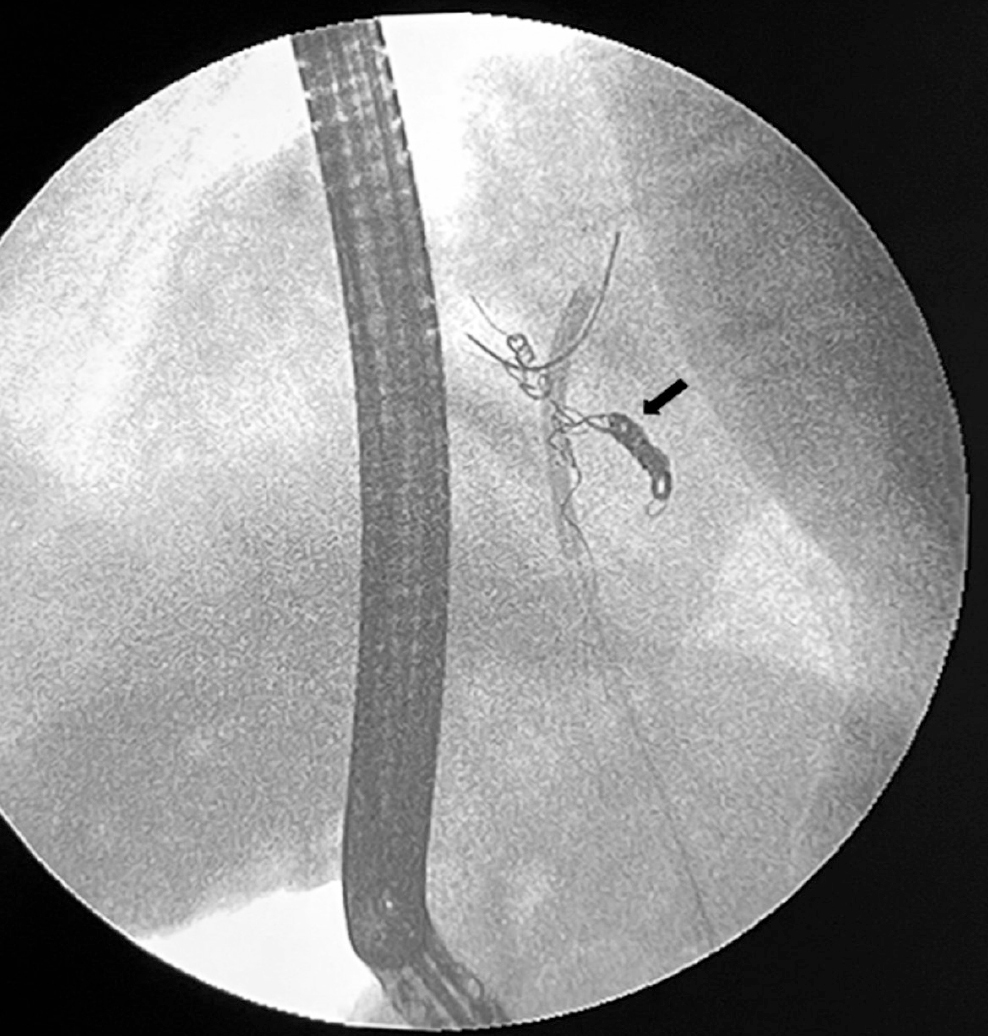
Embolization is a widely used procedure for managing both vascular and nonvascular conditions. However, the potential migration of coils into the biliary tract has been documented in medical literature, with clinical presentations often resembling biliary obstruction caused by choledocholithiasis. This report discusses two cases of coil migration into the biliary tract following arterial embolization and their subsequent endoscopic removal. Endoscopic management is the preferred approach; however, the technique used depends on the patient’s clinical condition and anatomical considerations.
Downloads
References
Bilbao JI, Martínez-Cuesta A, Urtasun F, Cosín O. Complications of embolization. Semin Intervent Radiol. 2006;23(2):126-42. https://doi.org/10.1055/s-2006-941443
Skipworth JRA, Morkane C, Raptis DA, Kennedy L, Johal K, Pendse D, et al. Coil migration - A rare complication of endovascular exclusion of visceral artery pseudoaneurysms and aneurysms. Ann R Coll Surg Engl. 2011;93(4):19-23. https://doi.org/10.1308/003588411X13008844298652
Bent CK, Wright L, Dong PR. “Coildocholithiasis”-Common Bile Duct Obstruction Secondary to Migration of Right Hepatic Artery Pseudoaneurysm Coils. J Vasc Interv Radiol. 2016;27(11):1741-3. https://doi.org/10.1016/j.jvir.2016.07.005
Zervos X, Molina E, Larsen MF. Colangitis secundaria a espirales metálicos emigrados al conducto biliar. Acta Gastroenterol Latinoam. 2013;43(2):146-8.
Turaga KK, Amirlak B, Davis RE, Yousef K, Richards A, Fitzgibbons RJ. Cholangitis after coil embolization of an iatrogenic hepatic artery pseudoaneurysm: An unusual case report. Surg Laparosc Endosc Percutaneous Tech. 2006;16(1):36-8. https://doi.org/10.1097/01.sle.0000202189.65160.ef
Schreuder AM, Van Gulik TM, Rauws EAJ. Intrabiliary Migrated Clips and Coils as a Nidus for Biliary Stone Formation: A Rare Complication following Laparoscopic Cholecystectomy. Case Rep Gastroenterol. 2018;12(3):686-91. https://doi.org/10.1159/000493253
Beard JI, Murphy S, Philips G. A Curious Case of Coil-Angitis. ACG Case Reports J. 2019;6(5):e00078. https://doi.org/10.14309/crj.0000000000000078
Pua U. Hepatobiliary and Pancreatic: Migration of hepatic coils into the biliary system. J Gastroenterol Hepatol. 2012;27(7):1256-1256. https://doi.org/10.1111/j.1440-1746.2012.07193.x
Zaafouri H, Hasnaoui A, Essghaeir S, Haddad D, Sabbah M, Bouhafa A, et al. Ascending Cholangitis secondary to migrated embolization coil of gastroduodenal artery pseudo-aneurysm a case report. BMC Surg. 2017;17(1):30. https://doi.org/10.1186/s12893-017-0227-9
Alghamdi HS, Saeed MA, Altamimi AR, O’Hali WA, Khankan AA, Altraif IH. Endoscopic extraction of vascular embolization coils that have migrated into the biliary tract in a liver transplant recipient. Dig Endosc. 2012;24(6):462-5. https://doi.org/10.1111/j.1443-1661.2012.01307.x
Ghalim F, Alatawi A, Leblanc S, Vienne A, Gaudric M, Chaussade S, et al. Endoscopic retrograde cholangioscopic removal of migrated vascular coils from the common bile duct. Clin Res Hepatol Gastroenterol. 2014;38(2):e31-2. https://doi.org/10.1016/j.clinre.2013.08.007
Zuberi OS, Dinglasan LA V. Biliary obstruction necessitating choledochojejunostomy as a complication of endovascular coil erosion. Radiol Case Reports. 2018;13(1):167-70. https://doi.org/10.1016/j.radcr.2017.10.015
Lee YS. Could the “SpyGlass Direct Visualization” System Open New Horizons for Treating Biliary Tract Diseases as a Percutaneous Cholangioscopy? Gut Liver. 2022;16(1):1-2. https://doi.org/10.5009/gnl210574
Downloads
Published
How to Cite
Issue
Section
License
Copyright (c) 2025 Revista colombiana de Gastroenterología

This work is licensed under a Creative Commons Attribution-NonCommercial-NoDerivatives 4.0 International License.
Aquellos autores/as que tengan publicaciones con esta revista, aceptan los términos siguientes:
Los autores/as ceden sus derechos de autor y garantizarán a la revista el derecho de primera publicación de su obra, el cuál estará simultáneamente sujeto a la Licencia de reconocimiento de Creative Commons que permite a terceros compartir la obra siempre que se indique su autor y su primera publicación en esta revista.
Los contenidos están protegidos bajo una licencia de Creative Commons Reconocimiento-NoComercial-SinObraDerivada 4.0 Internacional.