Enfermedad inflamatoria intestinal de inicio muy temprano refractaria a terapia anti-TNF
DOI:
https://doi.org/10.22516/25007440.1213Palabras clave:
Enfermedades Inflamatorias del Intestino, pediatría, Enfermedad de CrohnResumen
Antecedentes: la enfermedad inflamatoria intestinal (EII) de inicio muy temprano (VEO-IBD), definida por el inicio de síntomas antes de los 6 años, es un desafío clínico para el grupo tratante. El objetivo de este reporte de caso es compartir la experiencia al abordar a un paciente con enfermedad de inicio muy temprano.
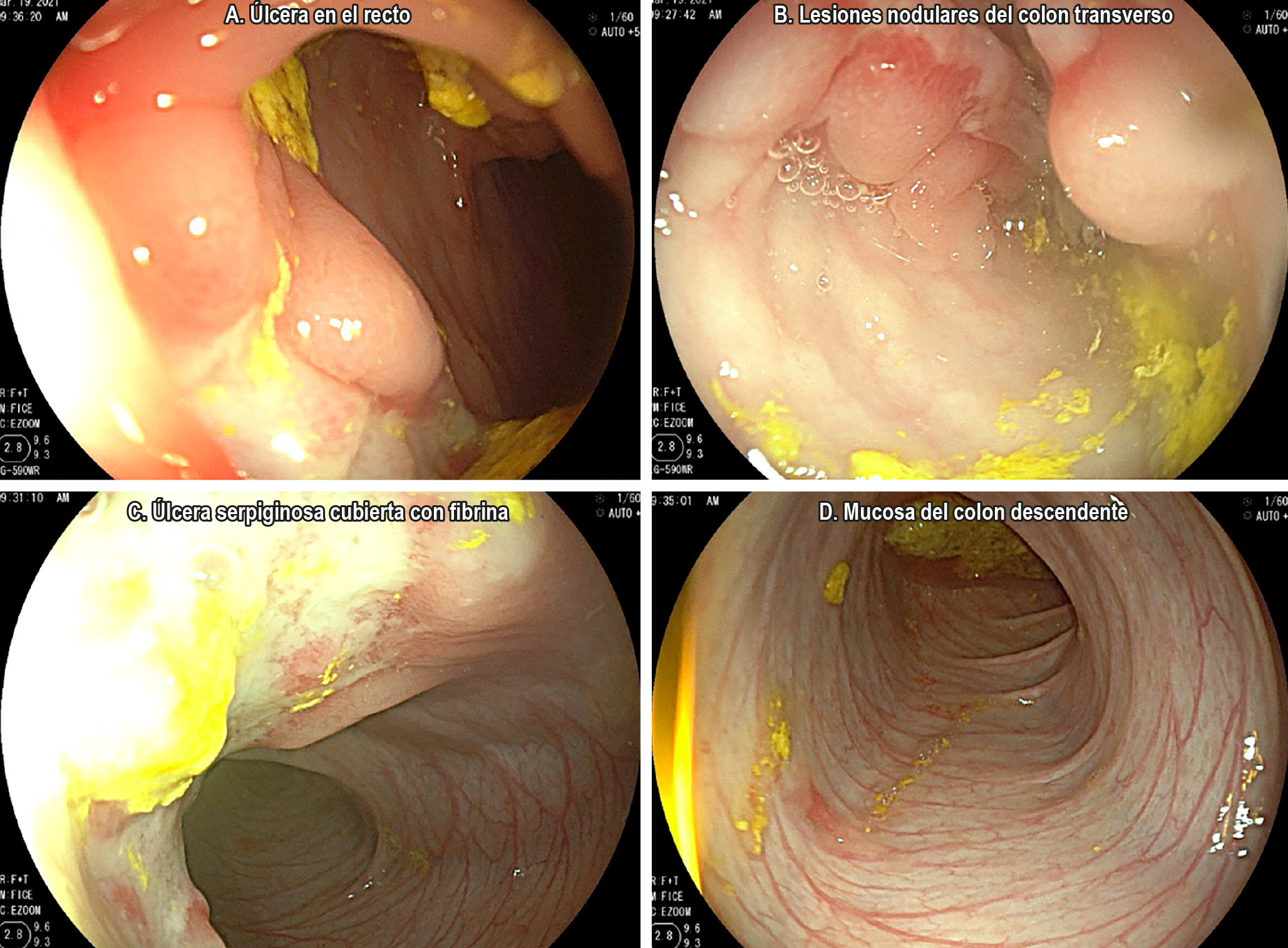
Caso clínico: se presenta el caso de un niño de 3 años con EII, fenotipo enfermedad de Crohn (EC), que debutó a los cuatro meses de edad. Se le realizó un abordaje exhaustivo para descartar diagnósticos diferenciales como alergias, inmunodeficiencias y tuberculosis intestinal. Dada la edad temprana, se consideró el componente genético y se efectuaron estudios genéticos. El paciente cursó con pancolitis y compromiso perianal, y fue estratificado como de alto riesgo según las guías de la ECCO-ESPGHAN. Luego de fallas terapéuticas con infliximab y adalimumab, se inició ustekinumab con éxito. Esta terapia ha logrado la remisión clínica hasta la fecha, y ha demostrado ser efectiva en casos refractarios de EC en la infancia.
Conclusiones: lograr un diagnóstico preciso ante la sospecha de EII pediátrica es importante seguir las recomendaciones establecidas en guías de práctica clínica para el diagnóstico y abordaje individualizado. Aunque la mayoría de casos de VEO-IBD se debe a una causa multifactorial, el componente genético puede tener una fuerte contribución, y esta asociación es más fuerte cuando la edad de inicio es en menores de 2 años. Los casos de VEO-IBD tienen un compromiso más grave en términos de extensión y comportamiento.
Descargas
Referencias bibliográficas
Kelsen JR, Sullivan KE, Rabizadeh S, Singh N, Snapper S, Elkadri A, et al. North American Society for Pediatric Gastroenterology, Hepatology, and Nutrition Position Paper on the Evaluation and Management for Patients with Very Early-onset Inflammatory Bowel Disease. J Pediatr Gastroenterol Nutr. 2020;70(3):389-403. https://doi.org/10.1097/MPG.0000000000002567
Cucinotta U, Arrigo S, Dipasquale V, Gramaglia SMC, Laganà F, Romano C, et al. Clinical Course of Very Early-Onset Inflammatory Bowel Disease. J Pediatr Gastroenterol Nutr. 2023;76(5):590-595. https://doi.org/10.1097/MPG.0000000000003730
Parente P, Pastore M, Grillo F, Fassan M, Francalanci P, Dirodi A, et al. Very Early Onset-IBD: evidence for the need of a multidisciplinary approach. Pathologica. 2022;114(1):3-11. https://doi.org/10.32074/1591-951X-336
Krauthammer A, Weintraub I, Shaoul R, Lev-Tzion R, Broide E, Wilschanski M, et al. Infantile-onset inflammatory bowel disease has variable long-term outcomes. Front Pediatr. 2023;11:1097779. https://doi.org/10.3389/fped.2023.1097779
Uhlig HH, Schwerd T, Koletzko S, Shah N, Kammermeier J, Elkadri A, et al. The diagnostic approach to monogenic very early onset inflammatory bowel disease. Gastroenterology. 2014;147(5):990-1007.e3. https://doi.org/10.1053/j.gastro.2014.07.023
Uhlig HH. Monogenic diseases associated with intestinal inflammation: Implications for the understanding of inflammatory bowel disease. Gut. 2013;62(12):1795-805. https://doi.org/10.1136/gutjnl-2012-303956
Kammermeier J, Dziubak R, Pescarin M, Drury S, Godwin H, Reeve K, et al. Phenotypic and genotypic characterisation of inflammatory bowel disease presenting before the age of 2 years. J Crohn’s Colitis. 2017;11(1):60-9. https://doi.org/10.1093/ecco-jcc/jjw118
Levine A, Koletzko S, Turner D, Escher JC, Cucchiara S, De Ridder L, et al. ESPGHAN revised porto criteria for the diagnosis of inflammatory bowel disease in children and adolescents. J Pediatr Gastroenterol Nutr. 2014;58(6):795-806. https://doi.org/10.1097/MPG.0000000000000239
Levine A, Griffiths A, Markowitz J, Wilson DC, Turner D, Russell RK, et al. Pediatric modification of the Montreal classification for inflammatory bowel disease: The Paris classification. Inflamm Bowel Dis. 2011;17(6):1314-21. https://doi.org/10.1002/ibd.21493
Singh SK, Srivastava A, Kumari N, Poddar U, Yachha SK, Pandey CM. Differentiation between Crohn disease and intestinal tuberculosis in children. J Pediatr Gastroenterol Nutr. 2018;66(1):e6-11. https://doi.org/10.1097/MPG.0000000000001625
Martín De Carpi J, Vila V, Varea V. Aplicación de los criterios de Oporto para el diagnóstico de enfermedad inflamatoria intestinal pediátrica en un centro pediátrico de referencia. An Pediatr. 2011;75(4):232-8. https://doi.org/10.1016/j.anpedi.2011.03.011
Van Rheenen PF, Aloi M, Assa A, Bronsky J, Escher JC, Fagerberg UL, et al. The Medical Management of Paediatric Crohn’s Disease: An ECCO-ESPGHAN Guideline Update. J Crohn’s Colitis. 2021;15(2):171-94. https://doi.org/10.1093/ecco-jcc/jjaa161
Vera-Chamorro JF, Sanchez-Franco C, Vargas-Sandoval M, Mora-Quintero DV, Riveros-López JP, Sarmiento-Quintero F, et al. Consenso colombiano de la enfermedad inflamatoria intestinal pediátrica. Rev Colomb Gastroenterol. 2023;38(Supl 1):1-75. https://doi.org/10.22516/25007440.943
Akkelle BS, Sengul OK, Volkan B, Tutar E, Ergelen R, Yardimci S, et al. Outcomes of pediatric fistulising perianal Crohn’s disease. Turkish J Gastroenterol. 2021;32(3):240-7. https://doi.org/10.5152/tjg.2021.191034
De Zoeten EF, Pasternak BA, Mattei P, Kramer RE, Kader HA. Diagnosis and treatment of perianal crohn disease: NASPGHAN clinical report and consensus statement. J Pediatr Gastroenterol Nutr. 2013;57(3):401-12. https://doi.org/10.1097/MPG.0b013e3182a025ee
Amil-Dias J, Kolacek S, Turner D, Pærregaard A, Rintala R, Afzal NA, et al. Surgical Management of Crohn Disease in Children: Guidelines from the Paediatric IBD Porto Group of ESPGHAN. J Pediatr Gastroenterol Nutr. 2017;64(5):818-35. https://doi.org/10.1097/MPG.0000000000001562
Brückner A, Werkstetter KJ, De Laffolie J, Wendt C, Prell C, Weidenhausen T, et al. Incidence and risk factors for perianal disease in pediatric Crohn disease patients followed in CEDATA-GPGE registry. J Pediatr Gastroenterol Nutr. 2018;66(1):73-8. https://doi.org/10.1097/MPG.0000000000001649
Wetwittayakhlang P, Al Khoury A, Hahn GD, Lakatos PL. The Optimal Management of Fistulizing Crohn’s Disease: Evidence beyond Randomized Clinical Trials. J Clin Med. 2022;11(11):3045. https://doi.org/10.3390/jcm11113045
Plevris N, Jenkinson PW, Arnott ID, Jones GR, Lees CW. Higher anti-tumor necrosis factor levels are associated with perianal fistula healing and fistula closure in Crohn’s disease. Eur J Gastroenterol Hepatol. 2020;32(1):32-7. https://doi.org/10.1097/MEG.0000000000001561
Yarur AJ, Kanagala V, Stein DJ, Czul F, Quintero MA, Agrawal D, et al. Higher infliximab trough levels are associated with perianal fistula healing in patients with Crohn’s disease. Aliment Pharmacol Ther. 2017;45(7):933-40. https://doi.org/10.1111/apt.13970
Kerur B, Fiedler K, Stahl M, Hyams J, Stephens M, Lu Y, et al. Utilization of Antitumor Necrosis Factor Biologics in Very Early Onset Inflammatory Bowel Disease: A Multicenter Retrospective Cohort Study From North America. J Pediatr Gastroenterol Nutr. 2022;75(1):64-9. https://doi.org/10.1097/MPG.0000000000003464
Hyams JS, Griffiths A, Markowitz J, Baldassano RN, Faubion WA, Colletti RB, et al. Safety and efficacy of adalimumab for moderate to severe crohn’s disease in children. Gastroenterology. 2012;143(2):365-374.e2. https://doi.org/10.1053/j.gastro.2012.04.046
Faubion WA, Dubinsky M, Ruemmele FM, Escher J, Rosh J, Hyams JS, et al. Long-Term Efficacy and Safety of Adalimumab in Pediatric Patients with Crohn’s Disease. Inflamm Bowel Dis. 2017;23(3):453-60. https://doi.org/10.1097/MIB.0000000000001021
Kelsen JR, Grossman AB, Pauly-Hubbard H, Gupta K, Baldassano RN, Mamula P. Infliximab therapy in pediatric patients 7 years of age and younger. J Pediatr Gastroenterol Nutr. 2014;59(6):758-62. https://doi.org/10.1097/MPG.0000000000000533
Weintraub Y, Collen Veit L, Hussey S, Mitrova K, Croft NM, Kang B, et al. P570 Efficacy and safety of Adalimumab in Very Early-onset IBD- A Multicentre Study from the Paediatric IBD Porto Group of ESPGHAN. J Crohn’s Colitis. 2024;18(Supplement_1):i1114-5. https://doi.org/10.1093/ecco-jcc/jjad212.0700
Marsal J, Barreiro-de Acosta M, Blumenstein I, Cappello M, Bazin T, Sebastian S. Management of Non-response and Loss of Response to Anti-tumor Necrosis Factor Therapy in Inflammatory Bowel Disease. Front Med. 2022;9:897936. https://doi.org/10.3389/fmed.2022.897936
Gisbert JP, Chaparro M. Ustekinumab to treat Crohn’s disease. Gastroenterol Hepatol. 2017;40(10):688-698. https://doi.org/10.1016/j.gastrohep.2017.08.006
Chapuis-Biron C, Kirchgesner J, Pariente B, Bouhnik Y, Amiot A, Viennot S, et al. Ustekinumab for Perianal Crohn’s Disease: The BioLAP Multicenter Study from the GETAID. Am J Gastroenterol. 2020;115(11):1812-20. https://doi.org/10.14309/ajg.0000000000000810
Dayan JR, Dolinger M, Benkov K, Dunkin D, Jossen J, Lai J, et al. Real World Experience with Ustekinumab in Children and Young Adults at a Tertiary Care Pediatric Inflammatory Bowel Disease Center. J Pediatr Gastroenterol Nutr. 2019;69(1):61-7. https://doi.org/10.1097/MPG.0000000000002362
Koudsi M, Martinez-Vinson C, Pigneur B, Willot S, Djamal D, Enaud R, et al. Ustekinumab use in pediatric inflammatory bowel disease: a French multicenter study from the pediatric GETAID. J Pediatr Gastroenterol Nutr. 2023;76(6):763-770. https://doi.org/10.1097/MPG.0000000000003758
Jin HY, Lim JS, Lee Y, Choi Y, Oh SH, Kim KM, et al. Growth, puberty, and bone health in children and adolescents with inflammatory bowel disease. BMC Pediatr. 2021;21(1):35. https://doi.org/10.1186/s12887-021-02496-4
Descargas
Publicado
Cómo citar
Número
Sección
Licencia
Derechos de autor 2025 Revista colombiana de Gastroenterología

Esta obra está bajo una licencia internacional Creative Commons Atribución-NoComercial-SinDerivadas 4.0.
Aquellos autores/as que tengan publicaciones con esta revista, aceptan los términos siguientes:
Los autores/as ceden sus derechos de autor y garantizarán a la revista el derecho de primera publicación de su obra, el cuál estará simultáneamente sujeto a la Licencia de reconocimiento de Creative Commons que permite a terceros compartir la obra siempre que se indique su autor y su primera publicación en esta revista.
Los contenidos están protegidos bajo una licencia de Creative Commons Reconocimiento-NoComercial-SinObraDerivada 4.0 Internacional.